Education • Extraction Methods • GoMushroom
Triple Extraction of Medicinal Mushrooms: Alcohol, Water and Pressure in One Process
Medicinal mushrooms contain compounds with different chemical properties. Triple extraction combines alcohol, hot water and pressure — to capture a broader spectrum from the same raw material.
Introduction
With medicinal mushrooms, it is not enough to ask which mushroom is in a product. Equally important is what has actually made it into the extract from that mushroom.
Medicinal mushrooms contain compounds with different chemical properties. Some dissolve more readily in water, others in alcohol, and others are trapped within a denser fungal matrix. This is why, in quality extraction, the choice of raw material is not the only factor — the sequence of processing steps matters just as much.
Triple extraction is an approach in which the same raw material is processed through several consecutive stages. The goal is not simply to obtain more extract, but a broader and more deliberate capture of compounds from the same mushroom.
What Is Triple Extraction?
Triple extraction is a process in which the same raw material is processed in three consecutive extraction stages. For medicinal mushrooms, this typically means alcohol extraction, hot water extraction and pressurised water extraction.
Each stage targets a somewhat different group of compounds and uses different extraction conditions. The alcohol phase is important for less polar compounds, the hot water phase for polysaccharides, beta-glucans and other water-soluble fractions, and the pressurised water phase for additional processing of the less accessible fungal matrix.
The purpose of triple extraction is not simply to obtain more extract, but to achieve a broader and more balanced spectrum of compounds from the same raw material.
Why Is Triple Extraction Used?
Triple extraction is used because different groups of compounds require different extraction conditions.
Medicinal mushrooms commonly contain several groups of compounds:
- water-soluble polysaccharides,
- beta-glucans,
- heteropolysaccharides,
- polysaccharide-protein complexes,
- glycoprotein fractions,
- less polar triterpenes,
- sterols,
- phenolic compounds,
- pigments and other complex components.
Water, ethanol, temperature, pressure and time do not act in the same way. This is why, for more demanding mushrooms, a single procedure is often a compromise.
Using only water yields primarily the water-soluble portion. Using only alcohol yields primarily the alcohol-soluble portion. For medicinal mushrooms, however, the interest is often in a broader spectrum of compounds: both less polar fractions and complex water-soluble macromolecules.
The purpose of triple extraction is therefore not simply "more beta-glucans" or "more extract", but a broader chemical profile: alcohol-soluble compounds, conventional water-soluble polysaccharides, and additional complex water-soluble fractions such as polysaccharide-protein complexes and glycoprotein fractions.
Why a Single Solvent Is Not Sufficient
The basic principle of extraction is straightforward: compounds dissolve more readily in solvents with similar chemical properties.
Water is a polar solvent and dissolves polar compounds well, such as polysaccharides and beta-glucans. Ethanol is less polar and therefore better captures compounds that dissolve poorly in water — for example triterpenes, sterols and certain phenolic compounds.
In mushrooms such as Reishi, two very different groups of compounds are often highlighted: polysaccharides and triterpenoids [2,3]. This clearly illustrates why a single extraction condition cannot be optimal for all compound groups.
For a broader explanation of extraction principles, see the article What Is Extraction?
The Mushroom Itself Is Also a Barrier
The second obstacle is not just solubility, but the structure of the mushroom itself.
The fungal cell wall is a mechanically stable network composed primarily of chitin, beta-glucans, proteins and other structural components. Glucans and chitin are key building blocks of the fungal cell wall and contribute significantly to its mechanical stability [1].
This structure limits solvent penetration into the material and affects how many compounds can actually pass into the extract.
Grinding increases surface area but does not eliminate this barrier on its own. Temperature, an appropriate solvent, time and, where necessary, additional physical techniques — such as ultrasound-assisted extraction — are also important.
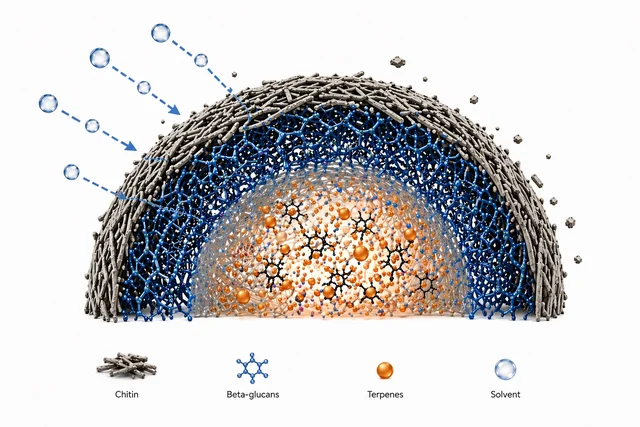
The fungal cell wall as an extraction barrier. The chitin matrix and beta-glucan network restrict solvent penetration to compounds inside the cell, which is why solvent choice and extraction method critically affect the final extract.
What Is Extracted from Individual Mushrooms
Reishi (Ganoderma lucidum)
Two groups of compounds are particularly important in Reishi: water-soluble polysaccharides, including beta-glucans, and less polar triterpenes. Research on Reishi frequently highlights polysaccharides and triterpenoids as key compound groups [2,3].
Multi-stage extraction is appropriate for Reishi because a single phase does not cover the full spectrum. The alcohol phase is important for less polar compounds, while the hot water phase addresses the polysaccharide and broader water-soluble portion.
For a denser and more complex raw material, additional pressurised water extraction makes technological sense, as it allows more intensive processing of the remaining fungal matrix and can contribute to a broader water-soluble profile of the extract.
Chaga (Inonotus obliquus)
Chaga contains polysaccharides, phenolic compounds, melanin and other complex components. Some compounds are readily accessible with water, while others require an alcohol or hydroethanolic phase.
Due to its hard structure and complex matrix, additional more intensive processing is often appropriate for Chaga.
With Chaga, the goal is not only to obtain one type of compound, but to make the best possible use of a complex raw material that contains both water-soluble and less polar components.
Lion's Mane (Hericium erinaceus)
The situation with Lion's Mane is somewhat different from that of denser mushrooms such as Reishi and Chaga. If the raw material is of good quality and both the alcohol and hot water extraction stages are carried out effectively, the transfer of water-soluble fractions into the extract may already be very high after the second stage.
During the development of our own extraction processes, we observed that ultrasound-assisted alcohol extraction can also influence the subsequent hot water phase. Probably due to more effective prior processing of the fungal matrix, the transfer of water-soluble fractions into the hot water extract was often very efficient.
Research into ultrasound-assisted extraction of mushrooms indicates that ultrasound can influence extraction efficiency and the transfer of compounds from fungal material into the solvent [4,5].
For Lion's Mane, we do not understand pressurised water extraction solely as a step to increase the total quantity of polysaccharides. Its additional value lies primarily in broadening the water-soluble profile of the extract.
With more intensive water processing, harder-to-access macromolecular fractions can also pass into the extract, such as heteropolysaccharides, polysaccharide-protein complexes, glycoprotein fractions and other complex water-soluble compounds.
This is important because the quality of a water extract cannot be understood solely through the quantity of beta-glucans or total polysaccharides. Molecular structure, molecular weight, degree of branching, solubility and the connection between the polysaccharide and protein components all matter too.
Pressurised water extraction therefore makes sense for Lion's Mane primarily as an additional processing stage for a broader chemical profile of the extract, not merely as a way to obtain "more" of the same fraction.
In practice, however, such a stage must always be balanced against the stability of the final formulation, as a high proportion of water-soluble macromolecules can affect the viscosity, filterability and usability of the liquid product.
How Multi-Stage Extraction Works
Multi-stage extraction means processing the same raw material through several consecutive stages. Each stage has its own purpose.
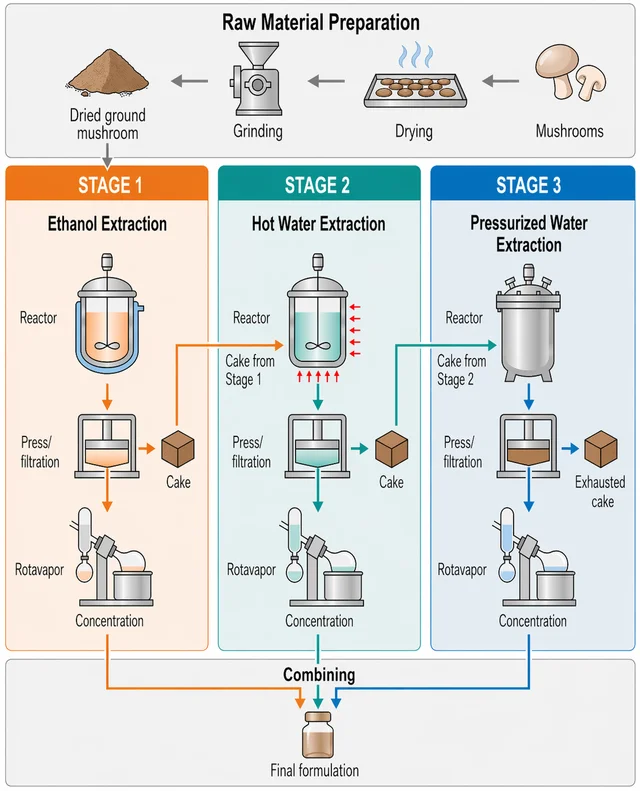
Triple extraction of medicinal mushrooms. A simplified overview of multi-stage extraction: ethanol extraction, hot water extraction and pressurised water extraction enable targeted extraction of different compound groups and their combination into the final formulation.
| Phase | Purpose | Typical conditions |
|---|---|---|
| Alcohol extraction | triterpenes, phenolics, sterols and less polar compounds | ~75–88% ethanol, often ultrasound-assisted |
| Hot water extraction | polysaccharides, beta-glucans and other water-soluble compounds | ~80–90 °C |
| Pressurised water extraction | additional release of less accessible water-soluble fractions from the fungal matrix | ~110–130 °C under pressure |
These ranges are not a universal recipe, but indicative conditions that are adjusted according to mushroom species, raw material quality, target compounds and final formulation.
Why the Term "Triple Extraction" Is Not Always Unambiguous
Terminology around extraction processes can easily cause confusion.
The term dual extraction in the context of medicinal mushrooms is usually applied to processes involving two different types of solvent: alcohol and water. The alcohol phase targets less polar compounds, while the water phase targets polysaccharides, beta-glucans and other water-soluble fractions.
The term triple extraction, however, does not necessarily mean three entirely different solvents. In our case, it refers to three processing stages:
- alcohol extraction,
- hot water extraction,
- pressurised water extraction.
GoMushroom triple extraction is therefore fundamentally still a combination of alcohol and water extraction, but the water portion is divided into two separate processing stages: conventional hot water extraction and an additional pressurised water extraction step.
The difference is therefore not only in the number of solvents, but in how the same raw material is processed. Dual extraction means two main solvent phases; our triple extraction means three consecutive processing steps, where the final stage enables additional treatment of the remaining fungal matrix.
What Is Pressurised Water Extraction?
Pressurised water extraction means using water at temperatures above the normal boiling point, where pressure prevents vigorous boiling and allows extraction at higher temperatures.
In mushroom processing, this approach is used as an additional water phase when more intensive treatment of the remaining fungal matrix is desired. In the scientific literature, this approach is described as pressurised hot water extraction, or PHWE.
A study on dried grey oyster mushroom (Pleurotus sajor-caju) investigated pressurised hot water extraction at 100–140 °C, 0.4–1.0 MPa and 20–60 minutes. The authors monitored the yield of crude polysaccharides, beta-glucans and phenolic compounds, and demonstrated that temperature, pressure and time significantly influence the extraction outcome [6].
Pressurised water extraction can therefore contribute to greater yields of water-soluble polysaccharide and polysaccharide-protein fractions.
Why Beta-Glucans Are Not the Only Important Compounds in the Water Phase
Beta-glucans are one of the best known and most frequently cited fractions of medicinal mushrooms. However, a water extract of a mushroom is not composed solely of beta-glucans.
With more intensive hot water and pressurised water extraction, other water-soluble macromolecular fractions can also pass into the extract, such as various polysaccharides, heteropolysaccharides, polysaccharide-protein complexes and glycoprotein fractions.
This is important because the biological profile of fungal polysaccharides does not depend solely on their quantity. Reviews of fungal polysaccharides emphasise that their properties are also related to molecular weight, monosaccharide composition, type of glycosidic linkages, degree of branching, spatial configuration and solubility [7,8].
Polysaccharide-protein complexes are particularly interesting because they do not represent merely a "sugar chain", but more complex macromolecules in which the polysaccharide portion is linked to a protein component. In the literature, such complexes from edible and medicinal mushrooms are described as an important class of bioactive compounds [9].
The goal of complex water extraction is therefore not necessarily to isolate just one group of compounds, but to capture a broader spectrum of naturally occurring water-soluble fractions from the mushroom. At GoMushroom, we also understand the final pressurised water phase in this context: as an additional processing option for obtaining a broader water-soluble profile when this makes technological and formulation sense for a given raw material.
An Example of Triple Extraction in Practice
A simplified example of the process for a more demanding mushroom such as Reishi:
- First, alcohol extraction is performed for less polar compounds.
- This is followed by hot water extraction for polysaccharides, beta-glucans and other water-soluble fractions.
- The remaining fungal matrix is additionally treated by pressurised water extraction.
- The individual fractions are filtered, concentrated and combined.
- Finally, a stable liquid formulation is prepared.
This is not a universal recipe, but the logic of the process. The actual conditions depend on the mushroom species, raw material quality and the goals of the final product.
Dual vs. Triple Extraction
| Property | Dual extraction | GoMushroom triple extraction |
|---|---|---|
| Number of solvent types | 2: alcohol + water | 2: alcohol + water |
| Number of processing stages | 2 | 3 |
| Alcohol phase | Yes | Yes |
| Hot water phase | Yes | Yes |
| Pressurised water phase | No | Yes |
| Capture of less polar compounds | Yes | Yes |
| Capture of water-soluble fractions | Yes | Yes |
| Additional processing of fungal matrix | No | Yes |
| Purpose | capturing alcohol-soluble and water-soluble compounds | broader capture + additional processing of fungal matrix |
| Process complexity | Lower | Higher |
| Recommended use | sufficient for many mushrooms | primarily for more complex raw materials or when a broader water-soluble profile is desired |
The difference between dual and triple extraction is therefore not only a matter of terminology. Dual extraction typically means two main solvent phases. GoMushroom triple extraction means three processing stages, where the final phase is not a third solvent, but additional pressurised water treatment.
Advantages of Triple Extraction
The main advantage of triple extraction is a broader capture of compounds from the same raw material.
A well-designed triple extraction process can enable:
- better utilisation of the same fungal raw material,
- a combination of alcohol-soluble and water-soluble fractions,
- additional processing of the harder-to-access matrix,
- a broader water-soluble profile of the extract,
- inclusion of harder-to-access polysaccharide and polysaccharide-protein fractions,
- a more deliberate final extract,
- greater process control.
This is particularly important for mushrooms where the relevant compounds are distributed across several chemically distinct groups, and where a single number — for example total beta-glucan content — does not describe the full extract profile.
Disadvantages of Triple Extraction
Triple extraction is not always the simplest choice.
- more processing steps,
- more filtration stages,
- more concentration steps,
- higher energy consumption,
- longer production time,
- greater equipment complexity,
- higher production cost.
In addition, the additional stage must make formulation sense. If very large quantities of water-soluble macromolecules are transferred into the liquid extract, this can affect the viscosity, filterability, stability and usability of the product.
More Is Not Always Better
More extraction stages do not automatically mean a better product.
If an additional stage does not contribute something useful or formulation-relevant, it is not technologically justified. For liquid extracts, what matters is not only how much material can be extracted, but also whether it can be incorporated into a stable, usable and purposeful final product.
Even with pressurised water extraction, higher temperature and longer time do not necessarily mean a better result. A study on grey oyster mushroom showed that more intensive conditions can affect different compound groups differently, including beta-glucans and phenolic compounds [6]. Pressurised extraction is therefore not simply a question of "higher temperature", but of finding the right balance between temperature, pressure, time and the extraction objective.
A good extract is not the result of the longest process, but of choosing the right process.
The GoMushroom Approach
At GoMushroom, we do not treat extraction as a single recipe for all mushrooms.
Each raw material has a different structure, a different chemical composition and a different response to solvent, temperature and ultrasound. The decision between dual and triple extraction is therefore made based on the raw material, yield, stability of the final formulation and the desired chemical profile of the extract.
Triple extraction is a tool, not a marketing label. It is used where it makes technological and substantive sense.
From our own measurements, the pressurised water phase contributes an additional 15% of dry extractable matter relative to the total triple extraction yield in more demanding mushrooms such as reishi. This is a measurable, not merely theoretical, contribution — and one of the reasons why a third stage is justified for demanding raw materials.
It is also important not to look at just one number on a label. Beta-glucans matter, but they are not the entire profile of a water extract. For a complex fungal raw material, we are interested in a broader chemical profile: beta-glucans, other polysaccharides, heteropolysaccharides, polysaccharide-protein complexes, glycoprotein fractions and smaller water-soluble compounds.
Is Triple Extraction Always Necessary?
Not in the same way for every mushroom.
Triple extraction is not a universal recipe that can be applied identically to all mushrooms. Its appropriateness depends on the raw material species, material quality, efficiency of the first two extraction stages, desired chemical profile and target formulation.
For Reishi and Chaga, additional pressurised water extraction is often appropriate, as these are denser and more complex materials.
For Lion's Mane, alcohol and hot water extraction often already enable very efficient transfer of water-soluble fractions into the extract. Pressurised water extraction for this mushroom is therefore not intended solely to increase total polysaccharide yield, but primarily to broaden the water-soluble profile — for example by including harder-to-access polysaccharide, polysaccharide-protein and glycoprotein fractions.
At the same time, such an additional stage must be technologically justified. For a liquid formulation, viscosity, stability, filterability and usability of the final product must all be taken into account. Triple extraction is therefore not about blindly adding steps, but making a considered process decision.
Why Most Manufacturers Do Not Use Triple Extraction
Triple extraction is slower, more expensive and technically more demanding.
It requires multiple separate extraction stages, more filtrations, more concentration steps, greater solvent management, more energy, more time and greater process discipline.
This is why, in the industry, it is often easier to use a simpler process that is cheaper and faster. However, such a process does not necessarily capture the same breadth of compounds.
For a quality extract, it is therefore important to understand that the difference lies not only in the name of the process, but in its actual execution.
Why Concentration Is a Critical Step
After extraction, the liquids obtained are relatively dilute. Without concentration, the final product would be weak and impractical to use.
Concentration is typically carried out under reduced pressure, where solvents evaporate at lower temperatures. This reduces the thermal load on the extract.
It is important to understand that the goal is not necessarily a dry powder. For liquid extracts, the aim is a concentrated extract that can be incorporated into a stable final formulation.
This step is as important as the extraction itself, as it determines whether the extract will be sufficiently concentrated, stable and practical for use. More on this process is explained in the article Vacuum Concentration.
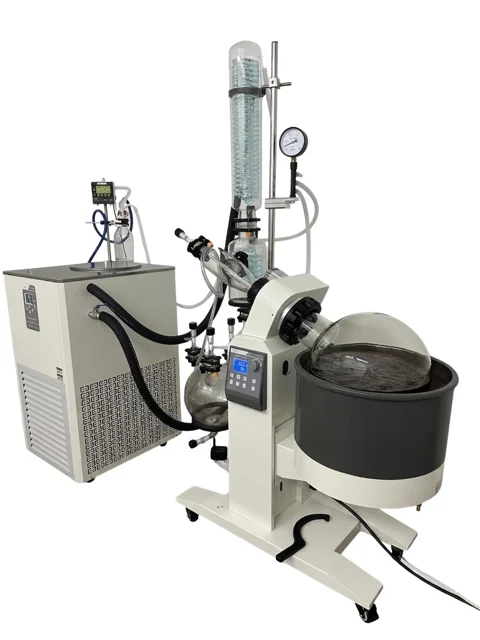
Rotary evaporator (rotavapor) removes solvents under reduced pressure at low temperatures. The result is not a powder — it is a concentrated liquid extract.
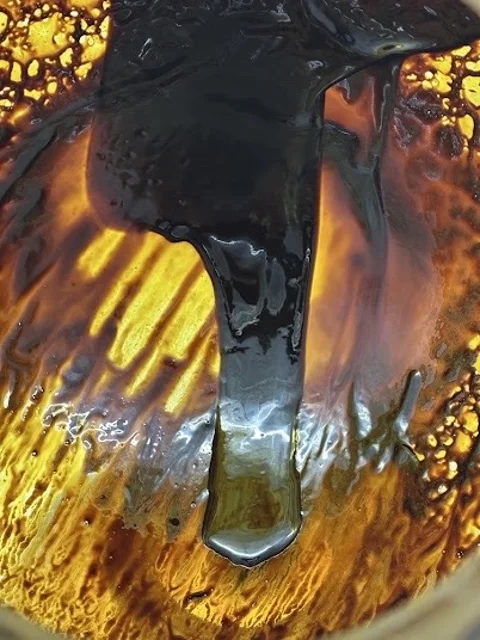
Reishi oleoresin concentrate — concentrated alcohol-soluble compounds (triterpenes, sterols, phenolics) after vacuum removal of ethanol. The dense, resinous fraction produced from the alcohol extraction phase.
Conclusion
Medicinal mushrooms contain different groups of compounds that require different extraction conditions. A single process is therefore generally not sufficient if the goal is to capture a broader spectrum of naturally occurring molecules.
Triple extraction is not the easiest path. Its advantage lies in enabling more thorough and deliberate processing of demanding raw materials such as Reishi and Chaga, and a broader water-soluble profile for mushrooms where the additional pressure stage makes technological and formulation sense.
With quality raw material and well-executed extraction, it is also necessary to assess what an additional stage actually contributes: greater yield, a broader chemical profile, better utilisation of the raw material — or primarily greater process complexity.
A good extract is not the result of the longest process, but of choosing the right process. For medicinal mushrooms, extraction is the bridge between the raw material and the final product — and it is often this bridge that determines the difference between an average and a seriously designed extract.
Frequently Asked Questions
What is triple extraction?
Triple extraction is a process in which the same raw material is processed in three consecutive extraction stages. For medicinal mushrooms, this typically means alcohol extraction, hot water extraction and pressurised water extraction.
Is triple extraction the same as dual extraction?
Not exactly. Dual extraction typically means two main solvent phases: alcohol and water. GoMushroom triple extraction also uses alcohol and water, but includes three processing stages: alcohol, hot water and pressurised water extraction.
Does triple extraction mean three different solvents?
Not necessarily. In our case, there are not three different solvents, but three processing stages. The water phase is divided into conventional hot water extraction and an additional pressurised water extraction step.
What is the difference between dual and triple extraction?
Dual extraction covers the alcohol and hot water phases. Triple extraction adds a third processing stage, in which the remaining fungal matrix is treated with water at higher temperature and pressure.
Why is alcohol used in mushroom extraction?
Because alcohol more effectively extracts less polar compounds such as triterpenes, sterols and certain phenolic compounds that are poorly soluble in water.
Why is hot water important?
Hot water is essential for extracting polysaccharides, beta-glucans and other water-soluble fractions. Temperature improves the transfer of compounds from the fungal matrix into the extract.
Why is pressure used?
Pressure allows water extraction at temperatures above the normal boiling point. This enables additional processing of the denser fungal matrix and can release compounds that are less accessible during conventional hot water extraction.
Is triple extraction always better?
Not always. More stages mean a broader and more complex process, but not automatically a better product. What matters is whether the additional stage actually contributes a useful, stable and chemically broader extract.
For which mushrooms is triple extraction most appropriate?
It is most appropriate for denser and chemically complex mushrooms such as Reishi and Chaga. For Lion's Mane, the pressure phase makes sense primarily as an additional processing stage for a broader water-soluble profile, not solely to increase the quantity of polysaccharides.
Why are beta-glucans not the only ones that matter?
Beta-glucans are an important fraction of medicinal mushrooms, but they are not the only water-soluble fraction. The extract may also contain other polysaccharides, heteropolysaccharides, polysaccharide-protein complexes, glycoprotein fractions and smaller water-soluble compounds. The quality of a water extract cannot always be understood through a single number.
Why is concentration important?
Because extracts after extraction are often too dilute. Concentration enables the preparation of a more useful liquid extract that can be incorporated into the final formulation.
Related Articles
References
- Gow, N. A. R., Latgé, J.-P., Munro, C. A. (2017). The Fungal Cell Wall: Structure, Biosynthesis, and Function. Microbiology Spectrum.
- Zhong, Y. et al. (2024). A Review of Ganoderma lucidum Polysaccharide: Preparations, Structures, Physicochemical Properties and Application. Foods, 13(17), 2665.
- Galappaththi, M. C. A. et al. (2023). A Review of Ganoderma Triterpenoids and Their Bioactivities. Biomolecules, 13(1), 24.
- Sun, M. et al. (2024). Drying, extraction of bioactive compounds, and post-harvest processing of edible mushrooms. Food Chemistry Advances.
- Zheng, S., Zhang, W., Liu, S. (2020). Optimization of ultrasonic-assisted extraction of polysaccharides and triterpenoids from the medicinal mushroom Ganoderma lucidum and evaluation of their in vitro antioxidant capacities. PLOS ONE.
- Sakdasri, W., Arnutpongchai, P., Phonsavat, S., Bumrungthaichaichan, E., Sawangkeaw, R. (2022). Pressurized hot water extraction of crude polysaccharides, β-glucan, and phenolic compounds from dried gray oyster mushroom. LWT, 168, 113895.
- Wang, Q. et al. (2017). Bioactive Mushroom Polysaccharides: A Review on Monosaccharide Composition, Biosynthesis and Regulation. Molecules, 22(6), 955.
- Yin, Z. et al. (2021). Immunomodulatory effects of polysaccharides from edible fungus: A review. Food Science and Human Wellness.
- Wu, J. (2015). Polysaccharide-Protein Complexes from Edible Fungi and Applications. In: Polysaccharides: Bioactivity and Biotechnology. Springer.