Education • Beta-Glucans • GoMushroom
Beta-Glucans in Medicinal Mushrooms: What the Numbers Really Mean
Beta-glucans are among the most discussed compounds when evaluating extract quality. But the number on a certificate of analysis alone does not reveal their structure, how they were extracted, or what that means for actual quality.
Beta-Glucans as a Quality Marker
In the world of medicinal mushrooms, beta-glucan content has become an almost universal quality marker. Percentages appear regularly on labels, specifications and sales materials, quickly creating the impression that a higher number automatically means a better extract.
This view is understandable — beta-glucans are among the most researched bioactive polysaccharides in mushrooms. But the number alone only tells part of the story. To evaluate an extract seriously, it is not enough to ask how much beta-glucan it contains. You also need to ask what kind of beta-glucans they actually are.
What Are Beta-Glucans
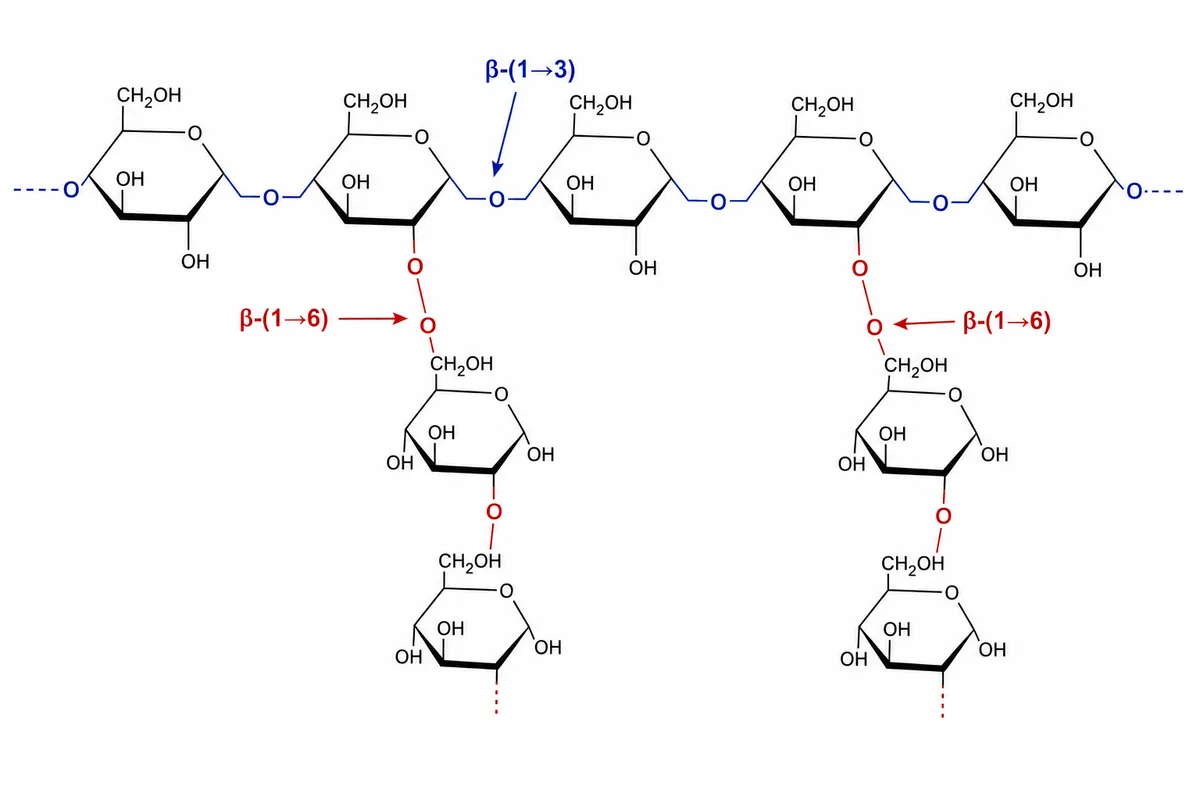
Beta-glucans are long, branched chains of glucose whose structure significantly influences their properties. [1,5]
These complex polysaccharides are found in the cell walls of fungi, yeasts and some grains. In medicinal mushrooms, they are of particular interest due to a structural arrangement that is connected to their biological activity. [1,3]
Beta-glucans are not a single molecule — they are a group of polysaccharides that differ in chain length, branching, molecular weight and spatial organization. These differences significantly influence their properties.
When we talk about beta-glucans from medicinal mushrooms, we are most commonly referring to polysaccharides with β-(1→3) and β-(1→6) linkages, which differ structurally from the beta-glucans found in grains such as oats and barley. [1,2]
What Beta-Glucans Do in the Body
Beta-glucans from mushrooms do not act like classic active compounds that directly "switch something on". Their activity is primarily connected to interaction with the immune system — in contact with specific immune cells, they can influence signaling pathways and modulation of immune response. [3,6,7]
Scientific literature refers to their interaction with receptors such as Dectin-1. [4,7] But what matters is not only the presence of beta-glucans — their three-dimensional structure, size, branching and conformation are also important. These properties affect how effectively binding can occur.
The biological activity of beta-glucans is not directly proportional to the percentage shown on an analysis. Equally important is the form in which they are present and how well their structure has been preserved.
Why the Number Alone Is Not Enough
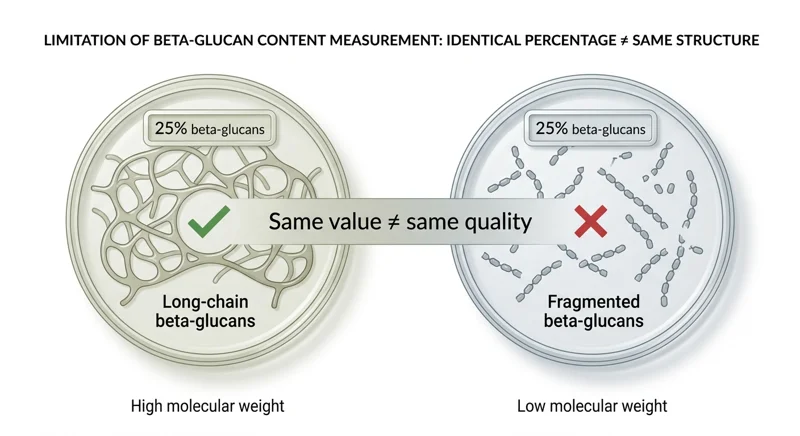
The standard analytical method for beta-glucans — an enzymatic assay (e.g. Megazyme) — measures the total amount of beta-glucans in a sample. This is useful for basic comparison and batch control. However, the method does not distinguish between long-chain, intact polysaccharides and short fragments. It does not report on molecular weight, degree of branching or the preservation of the three-dimensional conformation of the chains.
The result — expressed as a percentage — tells you how much beta-glucan is present. It does not tell you what kind. Two extracts with the same measured content can differ substantially in structural terms — and because biological activity depends precisely on structure, the number alone is not sufficient to judge quality. [4,5]
In practice, manufacturers frequently state beta-glucan content but rarely provide data on molecular weight, degree of branching or spatial arrangement. Such analyses require substantially more advanced techniques — including NMR spectroscopy, chromatographic methods for molecular weight determination or other structural analyses — and are therefore rarely encountered on commercial products. As a result, the beta-glucan percentage is often the only data point available to the consumer, even though it represents only part of the information about the actual polysaccharide structure.
Beta-Glucans, Alpha-Glucans and Total Polysaccharides
Polysaccharides are a large group of complex carbohydrates made up of long chains of glucose units. Both beta-glucans and alpha-glucans (e.g. starch) — along with many other related structures — fall within this category.
When a manufacturer states a total polysaccharide content, that figure includes all polysaccharides in the sample regardless of their structure. The number does not indicate what proportion of those polysaccharides are actually beta-glucans.
Alpha-glucans are polysaccharides with a different type of linkage between glucose units. They include starch and related storage forms of carbohydrates. As a result, an extract can contain a high proportion of total polysaccharides while its actual beta-glucan content is substantially lower. [1,2]
Beta-glucans represent only one subgroup of polysaccharides — but in medicinal mushrooms they are often of particular interest due to their characteristic β-(1→3) and β-(1→6) structure.
Total polysaccharide content and beta-glucan content are therefore not equivalent. Polysaccharide content tells you how many total polysaccharide compounds are present in a sample; beta-glucan content describes more specifically the presence of a particular polysaccharide subgroup.
This difference is most commonly seen in practice with extracts prepared from mycelium grown on grain substrate — for example on rice or barley. When the substrate and mycelium are not fully separated during processing, residual grain starch contributes to the measured total polysaccharide value. Although the enzymatic beta-glucan assay includes a starch removal step, residual grain polysaccharides can still affect the overall picture. The result is an extract with a high measured total polysaccharide content alongside a substantially lower content of genuine fungal beta-glucans.
Why Structure Matters So Much
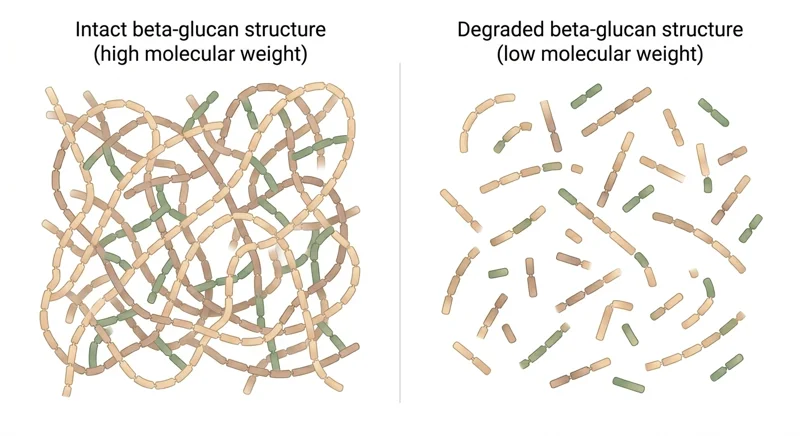
Immune cells — macrophages, dendritic cells, neutrophils — recognise beta-glucans through pattern recognition receptors, of which Dectin-1 is the most important. [4,7] This receptor recognises the β-(1→3)-glucan backbone with β-(1→6) branches in the specific three-dimensional conformation formed by long-chain fungal polysaccharides. When chains are fragmented or structurally altered, binding efficiency drops substantially.
The biological activity of beta-glucans is therefore closely connected to chain length, molecular weight, branching and spatial conformation. [4,5] An extract with a slightly lower beta-glucan percentage can in practice be more interesting than one with a higher number — if the polysaccharide structures in the first are better preserved. Percentage is easy to communicate. Structure tells you more.
The Role of Process: Where the Real Difference Is Made
Extract quality does not begin in the laboratory — it begins in the process. Beta-glucans are significantly affected by extraction conditions: temperature, time, pressure, pH and how the raw material is handled.
A gentle, well-controlled process better preserves complex polysaccharide structures. More aggressive conditions can cause depolymerization — shortening the chains. This does not mean beta-glucans disappear, but that their structural and functional activity can change. [4,5]
This is why the key question with any extract is always how it was made. A number without an understanding of the process tells substantially less than it might appear.
The goal of a quality extraction process is not merely the highest possible polysaccharide yield, but also the preservation of their natural structure to the greatest extent possible.
How the Industry Often Simplifies the Numbers
The market frequently presents formulations such as "40% beta-glucans" without further explanation. The figure may be analytically correct, but without context it does not tell the full story. It is not stated whether the extract comes from fruiting bodies or mycelium, what extraction method was used, or whether the value was measured for beta-glucans specifically or for total polysaccharides.
A common case involves exactly those extracts from mycelium on grain substrate, where a high measured polysaccharide value does not reflect the actual content of fungal beta-glucans — as covered in the previous section.
This is precisely why a serious product evaluation requires looking at the bigger picture: where the raw material comes from, what extraction process was used — and only then what the analytics show.
Beta-Glucans in Mushrooms vs. Other Sources
Beta-glucans are not found only in mushrooms. They are also present in oats, barley, yeasts and other natural sources — but with key structural differences.
Oat beta-glucans are β-(1→3)(1→4)-glucans, water-soluble and well known for their role in lowering cholesterol and regulating viscosity in the digestive tract. [6,8] Beta-glucans from medicinal mushrooms are β-(1→3)(1→6)-glucans, bound within cell walls alongside chitin — and are therefore insoluble in cold water. [1,2] Extracting them requires hot water or a combination with ethanol, which is one of the reasons why the extraction process matters so much for mushrooms.
Simply saying "beta-glucans" is therefore not enough — structure, source and solubility determine what an extract actually contains.
What to Look for When Choosing a Quality Extract
When evaluating a medicinal mushroom extract, it is worth looking beyond the number:
- Source — fruiting body or mycelium. Fruiting body extracts generally do not contain grain polysaccharides. Mycelium extracts grown on grain substrate require more care when interpreting analytical figures.
- Beta-glucans or total polysaccharides. Check whether the specification states beta-glucan content specifically (enzymatic method) or only total polysaccharides. These are different figures.
- Process transparency. Does the producer describe the extraction process? Extraction conditions directly affect the structure and integrity of polysaccharides.
- Dry matter content. A higher dry matter fraction in the final extract generally indicates more serious concentration.
None of these data points is an absolute indicator of quality on its own — but together they provide a significantly better picture than the beta-glucan figure alone.
Conclusion
Beta-glucans are one of the key quality parameters for medicinal mushroom extracts — but only when understood in the right context. The number on a certificate tells you how much is present. It does not tell you what kind they are or whether their structure is functionally relevant.
Quantity shows presence. Raw material source, extraction process and structural integrity show quality.
Key Points
- Beta-glucans are branched glucose chains with the characteristic β-(1→3)(1→6) structure that is key to their biological activity.
- The standard enzymatic assay measures quantity — not structural quality or chain integrity.
- Total polysaccharides ≠ beta-glucans: alpha-glucans and starch from grain substrates affect measured values.
- The Dectin-1 receptor recognises beta-glucans in a specific conformation — fragmented chains bind substantially less effectively.
- When choosing an extract, it is worth checking: raw material source (fruiting body / mycelium), analysis method and transparency of the extraction process.
Frequently Asked Questions
What are beta-glucans?
Beta-glucans are long, branched chains of glucose found in the cell walls of fungi, yeasts and some grains. In medicinal mushrooms, they are of particular interest due to their structural complexity and biological activity.
Does a higher beta-glucan percentage mean a better extract?
Not automatically. The total percentage only tells you how much is present, not the structural quality of those beta-glucans. Chain length, branching and extraction conditions all influence what is actually in the extract.
Why does the extraction process matter for beta-glucans?
Extraction conditions — temperature, time, pressure, pH and the type of processing — directly affect polysaccharide chains. Harsh conditions can cause depolymerization, shortening the chains and altering their properties.
What is the difference between total polysaccharides and beta-glucans?
Total polysaccharides include all polysaccharide compounds in a sample — beta-glucans, alpha-glucans, starch and others. Beta-glucans are a specific subgroup with the characteristic β-(1→3)(1→6) structure. A high total polysaccharide content therefore does not guarantee a high beta-glucan content.
Is it better for an extract to come from the fruiting body or from mycelium?
Fruiting bodies are the mushroom itself, naturally containing beta-glucans in the cell walls. Mycelium grown on grain substrate often contains residual grain polysaccharides that increase the measured total polysaccharide content without an equivalent contribution of genuine fungal beta-glucans. Fruiting body extracts are generally more straightforward to interpret analytically.
Related Articles
References
- Zhu, F. et al. (2015). β-Glucans from edible and medicinal mushrooms. Carbohydrate Polymers.
- Caseiro, C. et al. (2022). The Molecular Structure and Applications of β-Glucans. Biomolecules.
- Cerletti, C. et al. (2021). Edible Mushrooms and Beta-Glucans: Impact on Human Health. Nutrients.
- Han, B. et al. (2020). Structure-Functional Activity Relationship of β-Glucans From the Perspective of Immunomodulation: A Mini-Review. Frontiers in Immunology.
- Du, B. et al. (2019). A Concise Review on the Molecular Structure and Function Relationship of β-Glucan. International Journal of Molecular Sciences.
- Volman, J. J. et al. (2008). Dietary modulation of immune function by β-glucans. Physiology & Behavior.
- Novak, M. & Vetvicka, V. (2008). β-Glucans, History, and the Present: Immunomodulatory Aspects and Mechanisms of Action. Journal of Immunotoxicology, 5(1), 47–57.
- Murphy, E. J. et al. (2021). β-Glucans. Encyclopedia.