Education • Extraction Methods • GoMushroom
Ultrasonic Extraction of Medicinal Mushrooms: How Ultrasound Improves Extraction Efficiency
Ultrasonic extraction uses acoustic cavitation to speed up the transfer of compounds from mushroom to solvent and increase the yield of bioactive compounds.
Introduction
Two tinctures made from the same mushroom species, similar raw material and identical solvent can still contain noticeably different amounts of bioactive compounds. The reason is rarely the raw material itself — it is usually how much of it a producer actually managed to release from the mushroom into the extract. That is precisely the question ultrasonic extraction answers.
Ultrasonic extraction — internationally known by the abbreviation UAE (Ultrasound-Assisted Extraction) — is one of the more modern extraction methods, and in recent years it has also become established in the processing of medicinal plants and medicinal mushrooms.
Much of this material is trapped inside the mushroom's dense cell structure, which makes it harder for the solvent to reach. Conventional methods such as hot-water and ethanol extraction open this structure slowly, and their speed is often limited by diffusion and the mechanical resistance of the raw material. You can read more about the basic principles in the article What Is Extraction?
Ultrasound addresses this limitation directly — not through a different solvent, but through a different way of delivering energy into the system. In medicinal mushrooms, it is therefore not a standalone alternative to other methods, but a way to obtain more compounds from the same raw material in less time.
In the sections below, we explain how ultrasound actually works, why large differences appear between mushrooms and between producers, and how GoMushroom determined the conditions that give the highest yield for each raw material.
How Ultrasonic Extraction Works
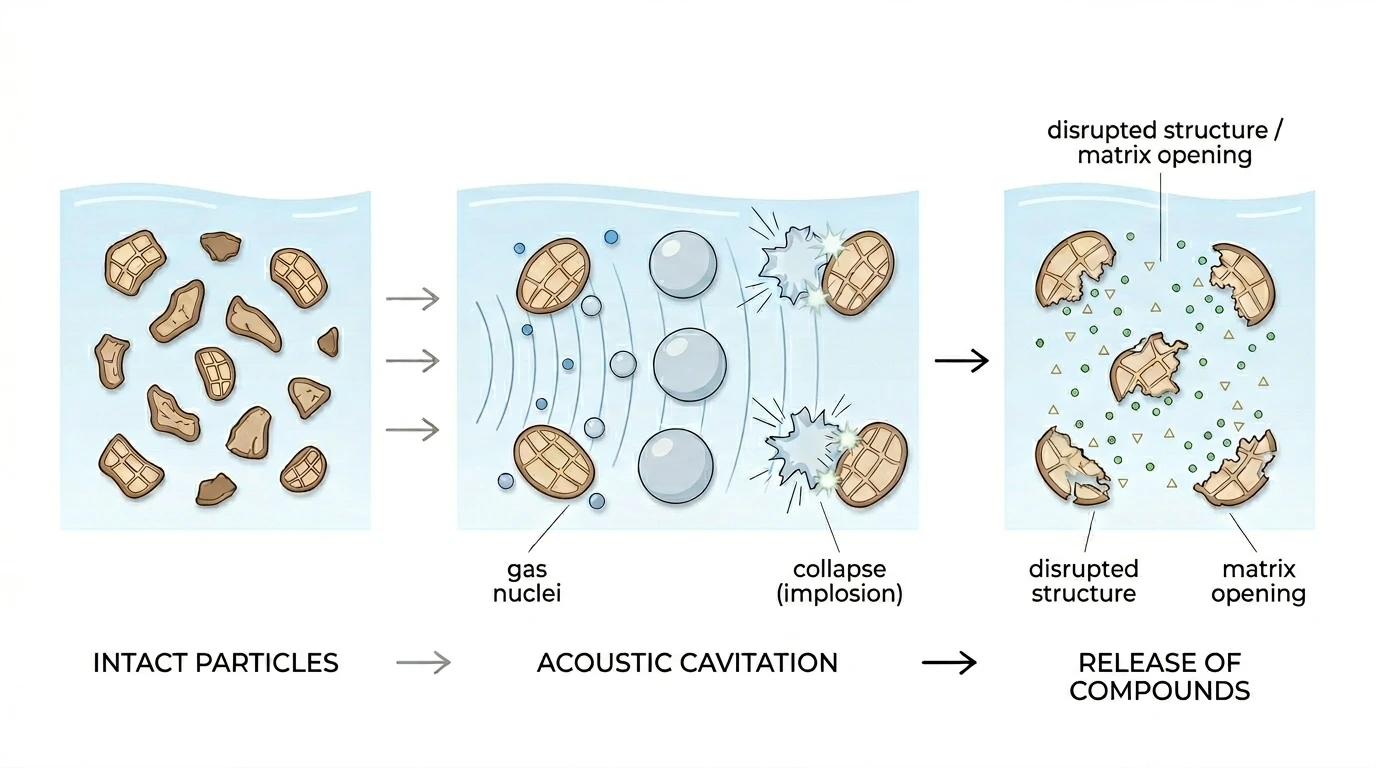
Ultrasonic extraction is based on a phenomenon called acoustic cavitation. Microscopic bubbles form in the liquid and collapse, creating local mechanical forces, micro-turbulence and short, highly intense energy impulses. [1]
These local effects act on the mushroom particles and on the boundary layer between the solvent and the solid material, which speeds up the transfer of compounds into the solvent. In simple terms, ultrasound helps break open the material's structure and improves contact between the solvent and the substances we want to extract.
Did you know? The energy released by the collapse of a single microscopic bubble can be thought of as an extremely short, highly localised burst of energy. It lasts a fraction of a millisecond, yet it is intense enough to mechanically affect its immediate surroundings — this is the driving force behind acoustic cavitation.
This effect is especially relevant in mushrooms, since the cell wall is not a simple structure — it is made up of chitin, beta-glucans and proteins that together form a mechanically resistant network. [5] [6]
Why Ultrasound Makes Sense for Mushrooms
Medicinal mushrooms contain several groups of bioactive compounds that are not equally accessible. Some dissolve well in water or ethanol, but that does not automatically mean they can easily leave the mushroom's cell structure and enter the extract.
The challenge, then, is not always solubility alone — it is often the structure of the raw material itself. If that structure stays too closed, part of these compounds remain trapped inside the mushroom even when the correct solvent has been chosen.
This is exactly where ultrasound helps: it speeds up the opening of the structure, reduces diffusion limitations and increases the efficiency of mass transfer. That can mean a faster process, a better yield, or both. [2] [3]
This is particularly useful for mushrooms such as Reishi, Chaga and Lion's Mane, which are dense-structured raw materials where mechanical accessibility is often the limiting factor in extraction.
Main Advantages of Ultrasonic Extraction
The main advantage of ultrasonic extraction is that it speeds up compound transfer without requiring extreme processing conditions. With proper control, this means a better yield can often be achieved even at moderate temperatures or within a shorter time.
In practice, this usually means:
- faster extraction,
- better contact between solvent and raw material,
- more efficient release of constituents from the mushroom's cell structure,
- better overall process yield.
Key takeaway: ultrasound does not change the chemistry of extraction — it changes the speed and completeness with which compounds move from the mushroom into the solvent. That is also where its real value lies: in a measurable effect on the physical course of the process, not in how advanced it sounds. [2]
What Needs to Be Controlled
Ultrasonic extraction is not automatically better under all conditions. As with any intensive technology, how it is used matters.
If treatment is too long or too aggressive, unwanted effects can occur — local overheating, changes to more sensitive compounds, or excessive mechanical stress on the extract. With polysaccharides and other complex structures, ultrasound therefore needs to be applied in a controlled way: with an appropriate treatment time, suitable cycles and careful temperature monitoring. [1]
The goal of ultrasound is not "maximum aggressiveness" — it is improved transfer under controlled conditions.
Ultrasonic Bath or Ultrasonic Probe?
Not all ultrasonic devices work the same way. The two types most commonly used in extraction are the ultrasonic bath and the ultrasonic probe, which differ mainly in how they transfer energy into the system. [1]
| Property | Ultrasonic probe | Ultrasonic bath |
|---|---|---|
| Frequency | ~20 kHz | ~40 kHz |
| Energy transfer | Directly into the medium | Indirectly, through a water bath |
| Cavitation intensity | High | Substantially lower |
| Adjustable intensity | Yes, adaptable to the raw material | Generally no |
| Device's primary purpose | Extraction, homogenisation | Cleaning equipment — extraction is a secondary use |
| Best suited for | Demanding laboratory and industrial extraction | Home use, small-scale experiments |
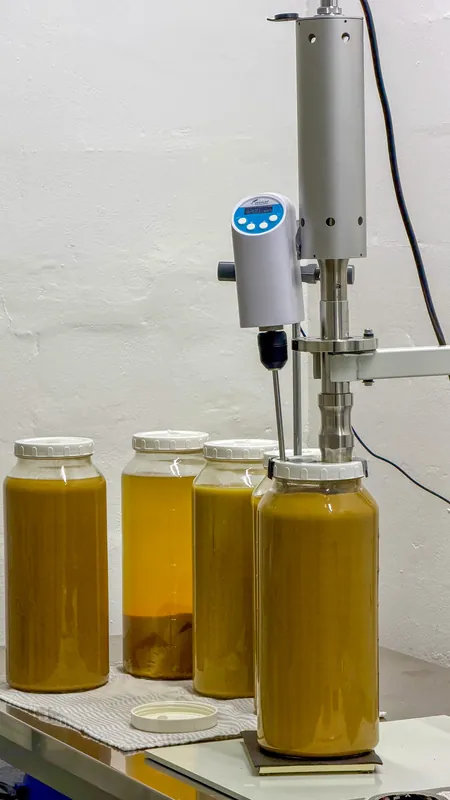
A probe delivers energy directly into the medium, enabling intense cavitation with adjustable intensity. That adjustability is its greatest strength — treatment intensity can be tailored to the raw material, since different mushrooms behave differently during extraction and do not require the same intensity. This allows yield to be optimised while reducing the risk of unwanted changes to sensitive compounds.
A bath was originally designed for cleaning laboratory equipment and jewellery, not extraction, so it is best suited to home use or smaller experiments. Despite its lower efficiency, it is still a noticeable improvement over conventional maceration without ultrasound — provided temperature is monitored and treatment is not extended for too long.
Why Power Alone Isn't the Whole Story
In ultrasonic extraction, frequency and rated device power are not the only things that matter. The actual intensity of cavitation is also influenced by system volume, mixing efficiency, the solvent-to-material ratio and the physical properties of the suspension itself.
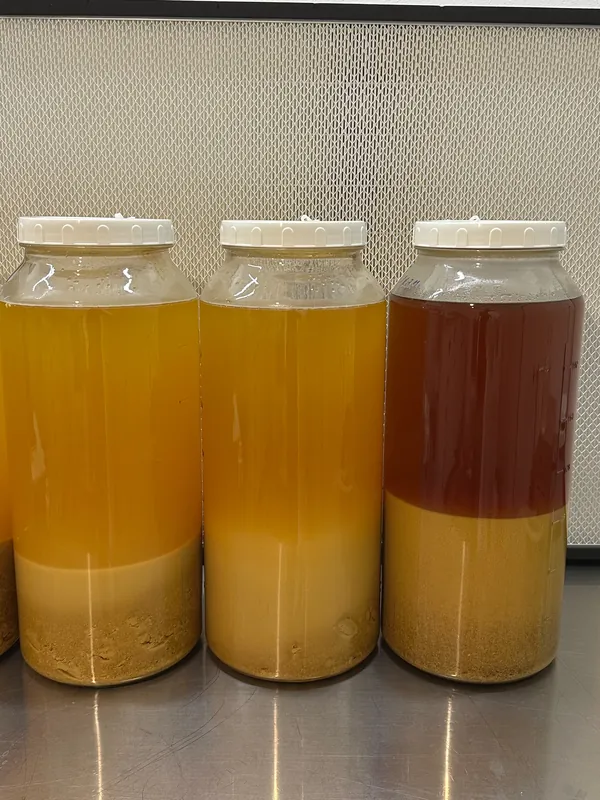
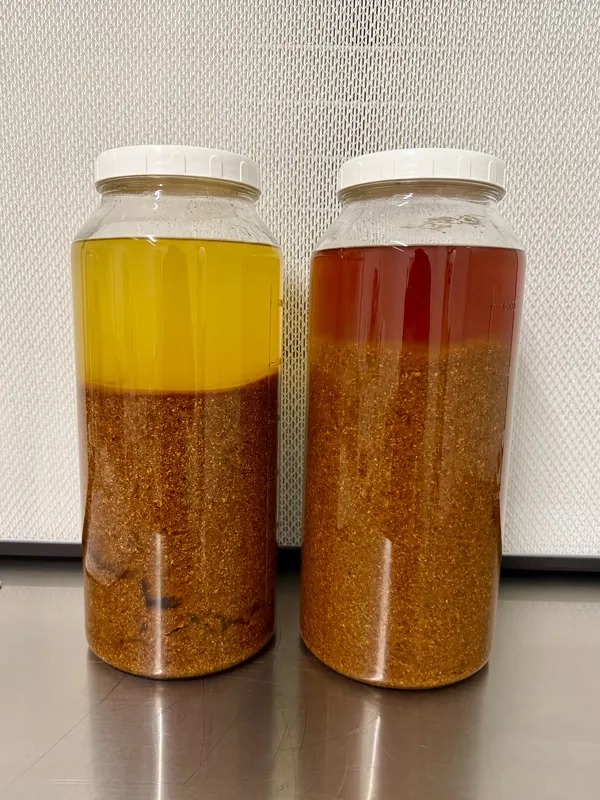
Different medicinal mushrooms can behave very differently during extraction. Reishi and Turkey Tail, due to their fibrous structure, often form significantly denser suspensions that dampen the propagation of ultrasonic waves and cavitation itself — which is why they require considerably more ultrasonic power than, for example, Lion's Mane, where the suspension is thinner and cavitation occurs far more readily. [4]
Practical example: at the same power setting, a thinner Lion's Mane suspension can cavitate evenly across the entire volume, while a dense Reishi suspension at the same power cavitates mainly near the probe. This difference has to be compensated for with higher intensity for denser raw materials.
As a result, some mushrooms often require larger amounts of solvent than would be used with thinner suspensions, while Lion's Mane typically allows work at lower solvent-to-material ratios, since its suspension is usually thinner and easier to process. The correct ratio matters not only for the concentration of the extract, but above all so the suspension remains fluid enough for effective mixing — only then is the entire contents of the vessel actually exposed evenly to cavitation, not just the area next to the probe.
The purpose of effective mixing is not to create a zone of very intense cavitation near the probe, but to ensure the most even treatment possible across the whole suspension. Without proper mixing, different parts of the system can receive very different amounts of energy.
Temperature monitoring is equally important, since sensitive molecules should not be exposed to excessive heat. From the difference between the suspension's temperature before and after treatment — given its mass and specific heat capacity — it is possible to calculate fairly precisely the actual ultrasonic energy, or average power, delivered to the system during treatment. This is an established calorimetric method for estimating effective ultrasonic power, which indirectly reflects the intensity of cavitation in the suspension. [1] On this basis, it is possible to estimate the optimal treatment time and power for a given raw material fairly reliably — rather than determining them purely by trial and error.
This approach is most reliably supported by measuring dry matter in the final extracts, since only this measurement directly shows whether a chosen combination of power, time and solvent ratio actually improved the yield.
At GoMushroom, we determined the optimal conditions for each mushroom in exactly this way — empirically, not purely theoretically. We started from power and time values published in the scientific literature, then tested different ultrasound intensities and different solvent-to-mushroom ratios for each raw material. For every combination, we measured dry matter in the filtered stock extract — a direct indicator of actual yield, not just a theoretical estimate. This is how we found, for each mushroom individually, the conditions that give the highest yield of extractable dry matter in the filtered stock extract.
In other words, every raw material in our process is extracted using parameters optimised specifically for it, not a single recipe applied to all mushrooms. A successful process is always the result of adapting to the specific raw material, its physical properties and the goals of the extraction.
Why Isn't Ultrasonic Extraction Standard Among All Producers?
If ultrasound genuinely improves yield, it is fair to ask why it isn't used by every producer of medicinal mushrooms.
The answer is mainly practical, not technical. A quality ultrasonic probe suitable for real extraction use is considerably more expensive than simple maceration or hot-water extraction equipment, and the process also requires additional mixing and temperature-control equipment.
Did you know? Beyond the cost of the device, the biggest expense is often time — as described above, there is no universal recipe. Every mushroom needs its own combination of power, time and solvent ratio, which means additional optimisation and measurement before the process even becomes repeatable in practice.
As a result, many producers — small and large alike — stay with simpler, established methods that are cheaper and quicker to implement, even if that means a somewhat lower yield of compounds. This reflects a different trade-off between process complexity, cost and yield rather than a wrong decision — and it is precisely why ultrasonic extraction is not (yet) an industry standard, but a differentiating factor among producers willing to invest in the process.
Ultrasound as Part of Multi-Stage Extraction
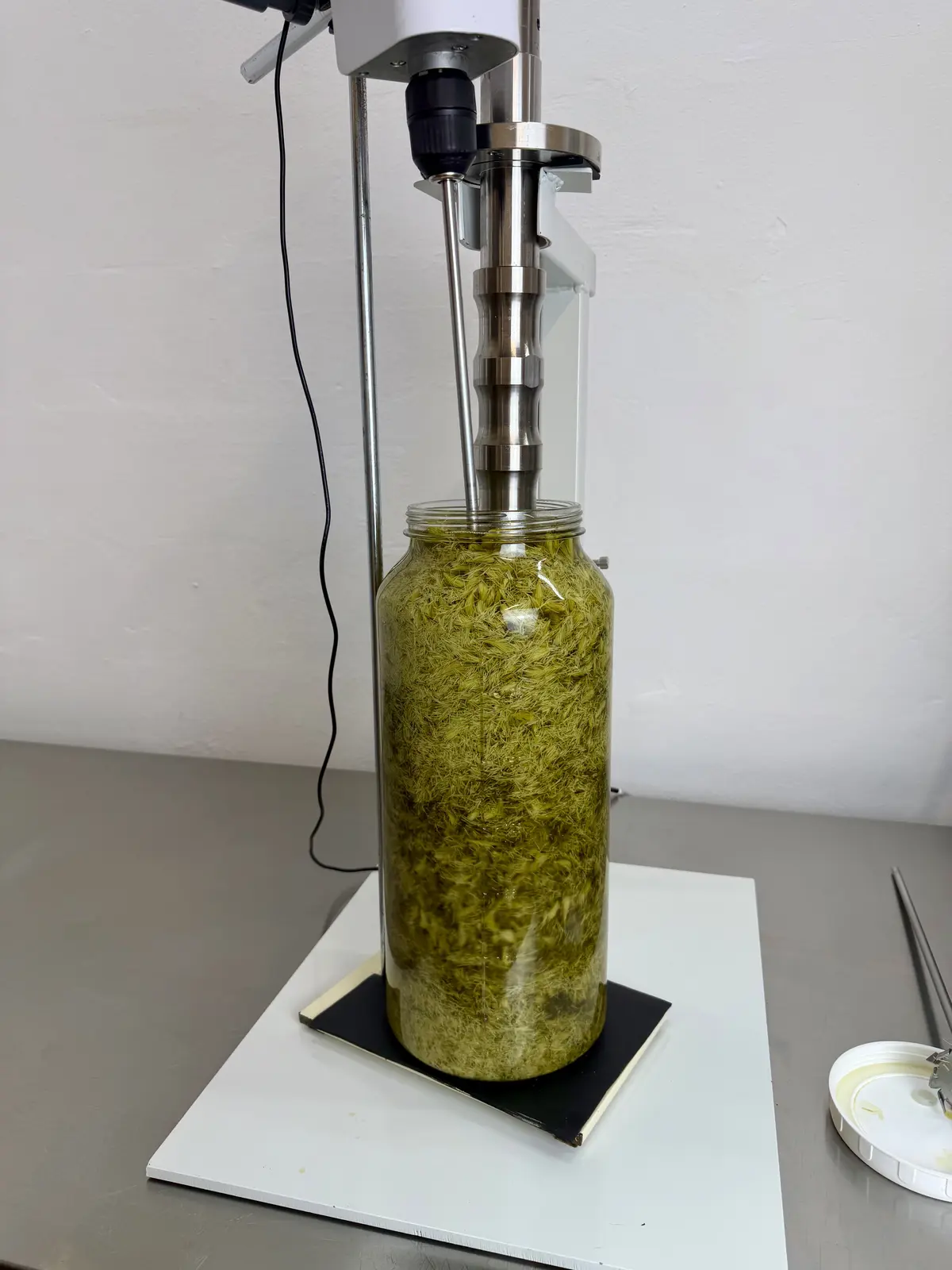
Ultrasonic extraction makes the most sense as part of a broader process. It does not replace the need for the correct choice of solvent, temperature or further processing — it complements these steps.
In multi-stage extraction, ultrasound can help in both the ethanol and water phases, since it speeds up the movement of compounds out of the raw material and increases contact between solvent and material. That makes it especially useful in processes designed to capture a wider spectrum of compounds from a single raw material while keeping good control over the process.
At GoMushroom, the ultrasonic probe is part of a controlled extraction process — integrated into both the ethanol and water phases of medicinal mushroom extraction. You can read more about the broader context of this approach in the article Triple Extraction of Medicinal Mushrooms.
What Ultrasound Means for Extract Quality
Ultrasonic treatment alone does not guarantee a quality extract. Quality is always the result of a combination of raw material, solvent, temperature, time, concentration and overall process design — ultrasound is just one of these factors, though an important one, since it improves a part of the process that is often overlooked with mushrooms: the accessibility of compounds within the raw material's cell structure.
The difference between a producer who uses ultrasound thoughtfully and one who adds it merely as an extra step lies mainly in how they verify that the treatment is actually working. At GoMushroom, we do not judge optimisation visually, nor do we simply assume it from the literature — every combination of power, time and solvent ratio is checked by measuring dry matter in the filtered extract. Only this measurement shows whether a chosen combination actually increased yield, or whether it merely looks that way.
This approach is slower than simply relying on published literature or experience from other industries, but it is the only way to ensure optimisation is actually tied to the specific raw material and process — not to a general assumption.
Conclusion
Ultrasonic extraction is not a marketing add-on — it is a physical tool that changes how quickly and how completely compounds move from mushroom to solvent. It does not change the chemistry of extraction and does not replace the correct choice of solvent, temperature or time; it helps those choices actually translate into results.
Its real value is not reflected in a product description, but in measured yield — in how much dry matter and how many bioactive compounds actually end up in the extract, not just in the raw material it came from.
Ultrasound is, above all, a tool for producers who want to understand, measure and optimise the process — not simply repeat established procedures.
Frequently Asked Questions
How does ultrasonic extraction work?
It relies on acoustic cavitation — bubbles in the liquid collapse and create mechanical forces that release compounds from the mushroom's cell structure into the solvent.
Does ultrasonic extraction replace other extraction methods?
No. Ultrasound improves existing extraction steps, it does not replace the correct choice of solvent or temperature. It is most effective as part of a multi-stage process.
Why is ultrasonic extraction particularly useful for medicinal mushrooms?
The mushroom cell wall is a dense structure made of chitin and beta-glucans that limits solvent access. Ultrasound helps open this structure and improves mass transfer.
What needs to be controlled during ultrasonic extraction?
The key variables are frequency (typically 20–40 kHz), amplitude (power intensity), solvent type, temperature and time. Each must be calibrated for the specific mushroom and target compound — too much power can degrade sensitive molecules.
Why does Reishi require more ultrasonic power than Lion's Mane?
Reishi's dense, fibrous structure creates a suspension that dampens cavitation considerably, so achieving the same extraction efficiency requires significantly more power than the thinner, more easily processed suspension of Lion's Mane.
How do you determine the optimal time and power for a given raw material?
From the difference between the suspension's temperature before and after treatment, given its mass and specific heat capacity, we can calculate fairly precisely the actual ultrasonic energy or average power the suspension received. Combined with dry-matter measurement of the final extract, this gives a reliable estimate of optimal time and power for each mushroom, instead of relying on trial and error.
How did GoMushroom determine the optimal extraction conditions for each mushroom?
We started from power and time values published in the scientific literature. We then tested different ultrasound intensities and solvent-to-mushroom ratios for each raw material and measured dry matter in the filtered stock extracts. Based on these measurements, we selected the conditions that gave the highest dry-matter yield for each mushroom.
Why isn't ultrasonic extraction standard among all producers?
Mainly for practical reasons: a quality ultrasonic probe suitable for real extraction use is considerably more expensive than simple maceration equipment, and the process requires additional optimisation for each raw material. There is no universal recipe, which is why many producers stay with simpler, established methods.
What is the difference between an ultrasonic bath and an ultrasonic probe?
An ultrasonic probe delivers energy directly into the extraction medium (~20 kHz) and enables intense cavitation with adjustable intensity — the standard for demanding extractions. An ultrasonic bath operates at higher frequencies (~40 kHz) and transfers energy indirectly through water, resulting in significantly lower cavitation intensity. For home use or less demanding extractions, a bath can be useful, but it does not match the efficiency of a probe.
Key Points
- Ultrasonic extraction is based on acoustic cavitation.
- In mushrooms, it helps improve access to compounds trapped inside the cell structure.
- Its main advantage is faster mass transfer and more efficient extraction.
- An ultrasonic probe is more effective than a bath for demanding extractions — it delivers energy directly into the medium at ~20 kHz.
- The solvent ratio must keep the suspension fluid enough that the entire vessel contents are actually exposed evenly to cavitation.
- Every mushroom needs a different power level — a dense Reishi suspension dampens cavitation far more than a thinner Lion's Mane suspension.
- From the temperature difference before and after treatment, we can estimate the actual ultrasonic energy delivered (a calorimetric method), and use this to choose optimal time/power, supported by dry-matter measurement of the extract.
- At GoMushroom, we determined the optimal conditions for each mushroom empirically — from literature starting points to testing intensities and ratios and measuring dry matter in filtered stock extracts.
- Because of equipment cost and the need for raw-material-specific optimisation, ultrasound is not (yet) an industry standard.
- Ultrasound makes the most sense as part of a broader multi-stage extraction process.
Related Articles
References
- Chemat, F. et al. (2017). Ultrasound assisted extraction of food and natural products. Mechanisms, techniques, combinations, protocols and applications. Ultrasonics Sonochemistry.
- Tiwari, B. K. (2015). Ultrasound: A clean, green extraction technology. TrAC Trends in Analytical Chemistry.
- Wen, C. et al. (2018). Advances in ultrasound assisted extraction of bioactive compounds from cash crops – A review. Ultrasonics Sonochemistry.
- Zheng, S., Zhang, W., Liu, S. (2020). Optimization of ultrasonic-assisted extraction of polysaccharides and triterpenoids from the medicinal mushroom Ganoderma lucidum and evaluation of their in vitro antioxidant capacities. PLOS ONE, 15(12): e0244749.
- Zhu, F. et al. (2015). β-Glucans from edible and medicinal mushrooms. Carbohydrate Polymers.
- Caseiro, C. et al. (2022). The molecular structure and applications of β-glucans. Biomolecules.