Education • Extraction Process • GoMushroom
Vacuum Concentration of Mushroom Extracts
Why removing solvent is just as important as extraction.
Why Concentration Matters After Extraction
Extraction is only half of the process.
Once bioactive compounds are transferred from the raw material into a solvent, the next critical step begins: concentration.
But before that, one important detail is often overlooked: effective extraction requires large volumes of solvent.
In practice, this can mean using 10× to 30× the weight of the mushroom material entering the extraction process.
This is not simply inefficiency. A higher solvent-to-material ratio supports better mass transfer, improves solvent contact with the material, and helps extraction proceed more completely. [2]
The result is a large volume of liquid extract — often diluted by design. This is why concentration is not optional. It is the step that turns extraction into a usable final product.
What Is Vacuum Concentration?
Vacuum concentration is a process where a liquid extract is evaporated under reduced pressure. By lowering the pressure inside the system, solvents such as ethanol or water can evaporate at lower temperatures than they would under normal atmospheric conditions.
Ethanol normally boils at around 78 °C. Under vacuum, it can evaporate at much lower temperatures, often in the range of 30–50 °C, depending on pressure and process conditions. [5]
This matters because many compounds in botanical and mushroom extracts are sensitive to excessive heat, oxidation and long exposure times.
Why Not Just Evaporate Normally?
At first glance, removing solvent may seem simple: apply heat and let it evaporate. In practice, this approach can change the extract.
High temperatures may increase degradation, remove volatile components, accelerate oxidation and shift the chemical profile of the extract. [3]
Vacuum concentration allows solvent removal to happen more gently, with better control over temperature and evaporation rate.
How a Rotary Evaporator Works
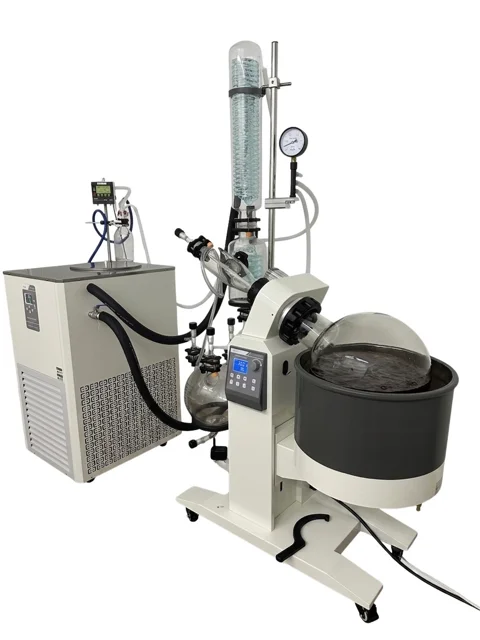
One of the most common laboratory systems for vacuum concentration is a rotary evaporator, also known as a rotavapor.
A rotavapor combines several process elements:
- an evaporating flask holding the extract, which rotates during the process,
- a heated water bath that supplies controlled energy,
- a vacuum pump with a pressure controller,
- a cooled condenser where vapours liquefy again,
- a chiller that cools the coolant circulating through the condenser,
- and a receiving flask where recovered solvent is collected.
As the evaporating flask rotates, the extract forms a thin film on the inner glass surface. This increases surface area and allows solvent to evaporate more efficiently. [4]
Vapours then travel into the condenser, where coolant chilled by the chiller — in our case to around −5 °C — circulates and condenses them back into liquid solvent, which drains into the receiving flask.
Why Pressure Doesn't Stay Constant During the Process
Ethanol is more volatile than water, so it evaporates preferentially during concentration. This means the mixture remaining in the flask becomes progressively more aqueous — its composition changes as the process runs.
The consequence matters: as ethanol concentration falls, the boiling point of the remaining mixture rises. If pressure were left unchanged, evaporation would gradually slow and eventually almost stop, leaving a diluted aqueous mixture in the flask.
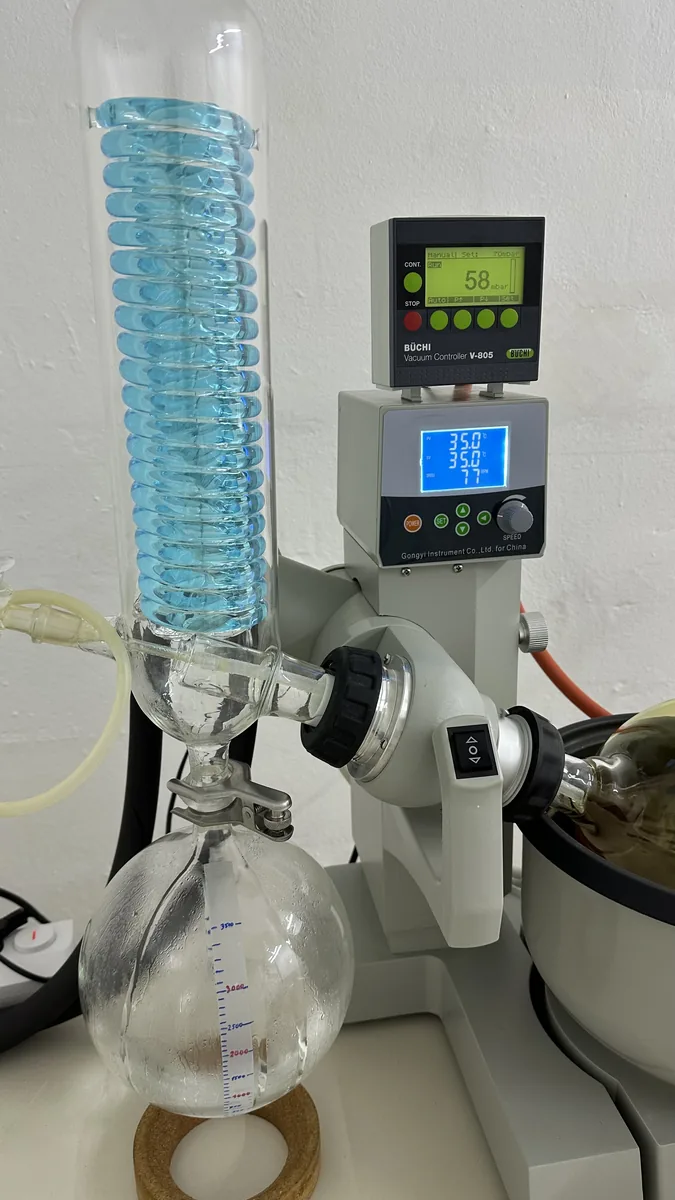
The answer is not to raise the temperature, since that would defeat the very advantage vacuum concentration exists to provide. Instead, the vacuum controller progressively lowers the pressure, keeping the mixture's boiling point below the set bath temperature throughout. The mixture therefore keeps evaporating from start to finish, without thermal spikes.
How strong this effect is becomes clear from the boiling points of both solvents at different pressures: [5][6]
| Pressure | Boiling point of ethanol | Boiling point of water |
|---|---|---|
| 1013 mbar (atmospheric) | 78 °C | 100 °C |
| 200 mbar | 42 °C | 60 °C |
| 100 mbar | 29 °C | 46 °C |
| 70 mbar | 23 °C | 39 °C |
| 50 mbar | ≈17 °C | 33 °C |
The table explains why a single fixed pressure setting is not enough. With the bath set to 35 °C, ethanol already boils at around 100 mbar, while water at that pressure does not come close — for water the pressure has to be pushed down towards 50 mbar. In the photograph above the controller sits at 58 mbar, where water boils at roughly 35 °C: exactly the range the process reaches in its final, largely aqueous phase.
Ethanol Mixtures and Aqueous Extracts Are Not the Same Problem
Because ethanol evaporates preferentially, the process splits in practice into two very different phases. While ethanol still dominates in the flask, concentration proceeds relatively quickly. Once the ethanol is gone and a largely aqueous extract remains, the process slows down substantially.
The first reason is the physics of the solvents themselves. At their atmospheric-pressure boiling points, evaporating one kilogram of water requires roughly 2.26 MJ of energy, while one kilogram of ethanol requires around 0.84 MJ — almost three times less. [5][6] That same heat also has to be removed at the other end of the system, since all vapour must condense back to liquid. Concentrating the aqueous phase therefore demands considerably more cooling capacity, and considerably more time, than removing ethanol.
In practice this means the chiller's cooling capacity becomes the limiting factor for the whole process. Evaporation can only proceed as fast as the resulting vapour can be condensed back to liquid. If the chiller cannot remove the heat being released, the vapour is not fully condensed — part of it passes the condenser towards the vacuum pump, where it is lost to the process.
Beyond the lost solvent, this also affects the mass balance. That balance rests on the mass of collected distillate: if some vapour escapes uncondensed, the collected mass no longer matches the amount actually evaporated, and the calculated ethanol concentration in the concentrate is wrong. Adequate cooling capacity is therefore not only a question of process speed, but a precondition for the measurement to be valid.
The second reason is the extract itself. The aqueous phase now holds all the extracted compounds — polysaccharides, beta-glucans, sugars, salts and other soluble components. These thicken the mixture and raise its viscosity, which makes it harder to form the thin film that evaporation depends on. They also raise the mixture's boiling point and bind part of the water, leaving it less available for evaporation. [4]
The result is that evaporation slows down of its own accord as the extract becomes denser: the more concentrated the extract, the harder it is to remove the next fraction of solvent. The final stage of concentration is therefore the slowest and most energy-intensive part of the whole process — and also the stage where temperature control matters most, because the extract is at its densest and under the greatest thermal load.
How Do We Know the Final Ethanol Concentration?
A practical question comes up during concentration: how do we actually know the current ethanol concentration in the extract being concentrated?
For plain binary mixtures of ethanol and water, refractive index or density measurements are fast, standard laboratory methods — reference tables and instruments are calibrated precisely for that two-component system. A medicinal mushroom extract is not a binary mixture, so neither method works reliably on it.
Refractive index is sensitive to the extract's colour — pigments and other dissolved compounds from the mushroom raw material distort the reading, since the method assumes only ethanol and water, not everything else that has passed from the raw material into the extract.
Density-based measurement fails for a similar reason: the extract's density depends not only on the ethanol:water ratio, but also on the concentration of dissolved solids, which raise density independently of ethanol content. Two batches with identical density can have very different ethanol content if they differ in extracted-solids content.
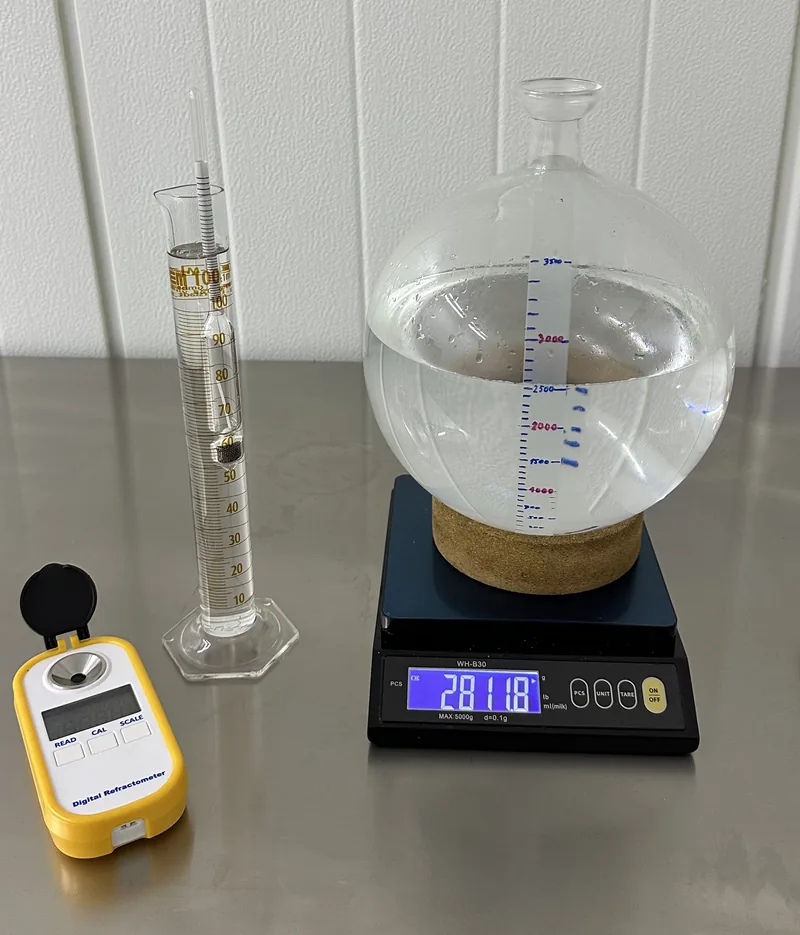
This is why at GoMushroom we rely on mass balance instead. We know precisely the composition (ethanol:water ratio) of the solvent used in extraction, and therefore the exact mass of ethanol that entered the process. The distillate produced during vacuum concentration (the condensate collected in the receiving flask), however, is — unlike the extract — actually a clean binary mixture of ethanol and water, since extracted compounds don't carry over into it during evaporation. This means the distillate's ethanol concentration can be measured simply and reliably using density or refractive index. With the known mass of the distillate and its measured ethanol concentration, mass balance lets us calculate how much ethanol has actually left the system — and, by extension, how much remains in the concentrated extract.
This approach doesn't require a direct measurement of the extract itself, where colour and dissolved solids would distort the result. Instead, it takes advantage of the fact that the distillate is a simple binary mixture that can be measured precisely, and combines that reading with a mass balance across the whole system: what went in, what left as distillate, and what remains is what's left in the extract.
Bumping and Foaming
Everything described so far holds as long as evaporation proceeds calmly. In practice, with mushroom extracts the greatest risk is that boiling is not smooth but sudden.
The first phenomenon is bumping. If pressure is dropped too quickly, or if the liquid lacks enough sites for bubbles to form, the mixture can superheat above its boiling point. When boiling finally starts, it starts all at once: a large vapour bubble forms and throws part of the contents up towards the condenser.
The second is foaming. Mushroom extracts contain proteins, polysaccharides and other surface-active compounds that stabilise foam. The more concentrated the extract, the more prone to foaming it becomes — and foam can climb through the neck of the flask and end up taking the same route. [4]
The consequence is not only lost product. If part of the extract carries over into the distillate, the distillate is no longer a clean binary mixture of ethanol and water — and that assumption is exactly what the mass balance described above rests on. A density or refractive index reading taken on a contaminated distillate gives a wrong result, which in turn makes the calculated ethanol concentration in the concentrate wrong too. A single bumping episode therefore spoils not just the batch, but the very data the process control depends on.
This is why the final stage demands the most attention. In practice that means:
- pressure is lowered gradually rather than in steps,
- flask rotation is never stopped, since it continuously renews the surface and prevents local overheating,
- the flask is not filled beyond half its volume, leaving headspace for any foam,
- the bath temperature is kept close to the mixture's boiling point rather than well above it, since too large a temperature difference makes boiling more violent.
One of the Most Demanding Process Steps
Vacuum concentration is one of the most energy-intensive parts of extract production.
Heat must be supplied to the water bath, vacuum must be maintained throughout the process, and cooling must run continuously to condense evaporated solvent.
This makes concentration slower, more technical and more expensive than simply mixing raw material with solvent. But it is also one of the steps that defines the quality and density of the final product.
Why This Step Is Often Minimized in Industry
From an industrial cost perspective, deep concentration is not convenient.
It requires equipment, energy, time, trained operators and process control. For this reason, many large-scale processes are designed to minimize solvent volume, shorten extraction, reduce concentration time or convert extracts into powders early in the process.
This does not automatically make those products poor. But it does show that production choices are often driven by cost, throughput and logistics — not only by extraction completeness.
Concentration Defines the Final Extract
Extraction determines what is transferred from the mushroom into the solvent — in our case through a multi-stage triple extraction process. Concentration determines how much of that extract ends up in the final product.
Two extracts may start from similar raw material and similar solvents, but differ significantly depending on how they are concentrated and formulated.
Proper vacuum concentration allows:
- higher compound density,
- better control over final formulation,
- partial solvent recovery,
- reduced unnecessary dilution,
- and greater batch-to-batch process consistency.
Solvent Recovery Matters
Vacuum concentration is not only about removing solvent. It also allows part of the solvent, especially ethanol, to be recovered.
Ethanol is an effective extraction solvent, but it is also expensive. By condensing evaporated ethanol back into liquid form, it can be collected and reused in future extraction cycles where appropriate process controls are in place. [1]
This makes solvent recovery both an economic and environmental advantage.
The Hidden Step Behind Concentrated Extracts
Vacuum concentration is rarely discussed in marketing, yet it is central to the production of concentrated extracts.
Without it, extraction produces a large amount of liquid. With it, that liquid can be transformed into a controlled, dense and usable extract.
In other words: extraction pulls compounds out. Concentration brings them together.
Conclusion
High-quality extraction often requires large solvent volumes. This improves extraction efficiency but naturally creates a diluted liquid extract.
Vacuum concentration is the process that solves this problem. It removes excess solvent gently, supports solvent recovery and gives the producer better control over the final formulation.
For liquid mushroom extracts, concentration is not just a technical detail. It is one of the defining steps between a simple extract and a concentrated final product.
Every GoMushroom extract goes through controlled vacuum concentration.
👉 See the products in our shopFAQ
What is vacuum concentration?
Vacuum concentration is a process where solvent is removed from a liquid extract under reduced pressure, allowing evaporation at lower temperatures.
Why is vacuum used when concentrating extracts?
Vacuum lowers the boiling point of solvents such as ethanol and water. This allows gentler evaporation and helps protect heat-sensitive compounds.
Why does extraction require so much solvent?
Effective extraction often requires a high solvent-to-material ratio to improve mass transfer, solvent penetration and contact with the raw material.
Is vacuum concentration necessary?
For concentrated liquid extracts, vacuum concentration is an important process step. It removes excess solvent while preserving the extract as gently as possible.
Why does the extract foam during concentration?
Mushroom extracts contain proteins, polysaccharides and other surface-active compounds that stabilise foam. The more concentrated the extract becomes, the more prone to foaming it is.
Related Articles
References
- Chemat, F. et al. Green extraction of natural products. International Journal of Molecular Sciences.
- Azmir, J. et al. Techniques for extraction of bioactive compounds from plant materials: A review. Journal of Food Engineering.
- Ratti, C. (2001). Hot air and freeze-drying of high-value foods: a review. Journal of Food Engineering.
- Berk, Z. Evaporation. In: Food Process Engineering and Technology. Academic Press, 2018.
- NIST Chemistry WebBook — Ethanol: vapour pressure and enthalpy of vaporisation. National Institute of Standards and Technology.
- NIST Chemistry WebBook — Water: vapour pressure and enthalpy of vaporisation. National Institute of Standards and Technology.