Services · GoMushroom
Reishi Cultivation (Ganoderma lucidum)
In-house cultivation of Reishi from culture to fruiting body – with control over the process, the morphology, and traceability through to the extract.
At GoMushroom we grow our Reishi ourselves – from selecting and propagating the culture through to substrate preparation, colonization, and fruiting body development.
This gives us tighter control over the raw material going into extraction, and traceability from the culture to each individual batch of extract or tincture.
With Reishi, growing conditions can also be steered towards the development of the distinctive antler morphology.
Why we grow our own Reishi
In extraction we can control temperature, time, alcohol concentration, and the ratio of raw material to solvent precisely.
But extraction can only draw out of a raw material what is already in it.
That is why, at GoMushroom, the quality of an extract begins in cultivation.
Growing our own gives us control over:
- the origin of the culture,
- the composition and preparation of the substrate,
- colonization,
- fruiting conditions,
- the morphology of the fruiting body,
- traceability through to the finished extract.
Our process runs in this sequence:
culture → agar → grain colonized with mycelium → wood substrate → colonization → fruiting → extraction
It all starts with mycelium
What we usually call a mushroom is the fruiting body. Most of the fungal organism is the mycelium – a network of fine hyphae spreading through the substrate.
A Reishi tincture therefore does not begin, for us, with a dried fruiting body, but with the culture the fruiting body has yet to grow from.
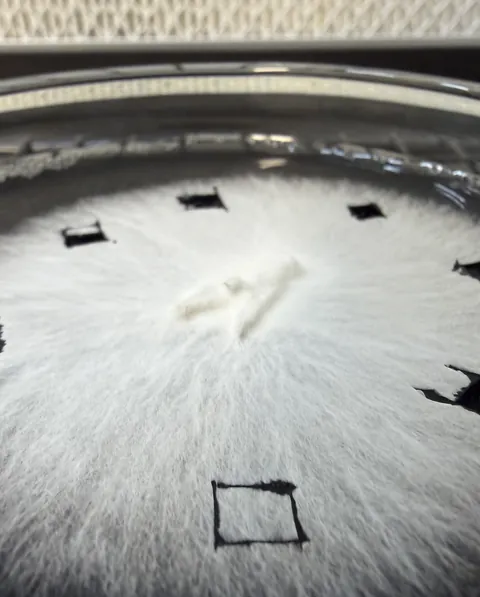
From inside a selected fruiting body we take a small piece of tissue and transfer it onto sterile agar. The work is done in filtered airflow and with sterilized tools.
From that tissue, the mycelium gradually grows across the agar and forms a colony.
Selecting and propagating the culture
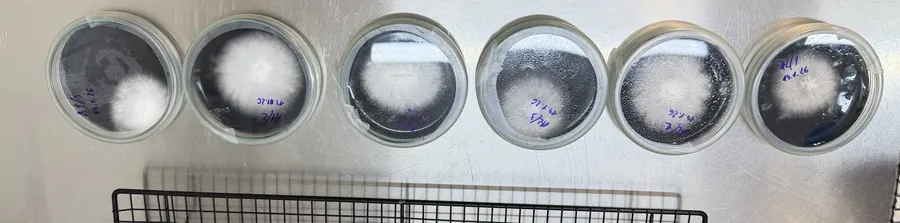
Individual colonies can differ in growth rate, density, and evenness.
So we prepare several plates and compare them as they grow.
From a healthy, evenly growing colony we transfer small pieces of colonized agar onto fresh sterile plates, building a working set of cultures from a single source.
Why the mycelium goes onto grain
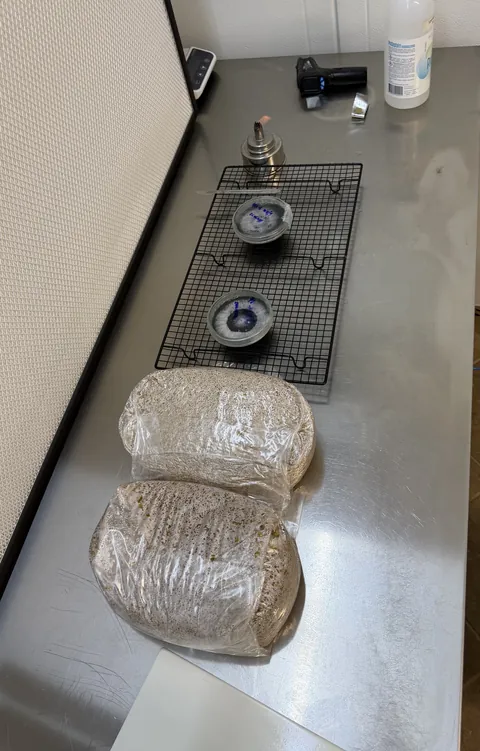
Mycelium could be transferred straight from an agar plate into wood substrate, but that would create only a handful of starting points for growth.
So we use grain colonized with mycelium instead.
Once the mycelium has grown through the individual kernels and we mix them evenly into the wood substrate, every kernel becomes a new point of inoculation.
Instead of a few starting points, we get hundreds of them spread through the whole block.
This shortens the distance the mycelium has to cover considerably, and allows faster, more even colonization of the substrate.
With our cultures, under suitable conditions on a flat surface, the edge of a colony can be seen advancing by roughly 5–10 mm a day; the actual rate depends on temperature, humidity, substrate composition, and other conditions.
Wood substrate and colonization
Reishi is a wood-decay fungus, so the base of our substrate is beech sawdust.
To it we add wheat bran and a smaller proportion of grain, which raise the nutritional value of the substrate.
The mixture is hydrated, weighed, and filled into filter grow bags.
What follows is a long thermal treatment in an atmospheric steam system. Because the process runs at normal air pressure and at a lower temperature than autoclaving, we use a longer treatment time.
The purpose of this step is to greatly reduce the microbial load of the substrate.
The cooled bags are then inoculated with grain colonized by Reishi mycelium.
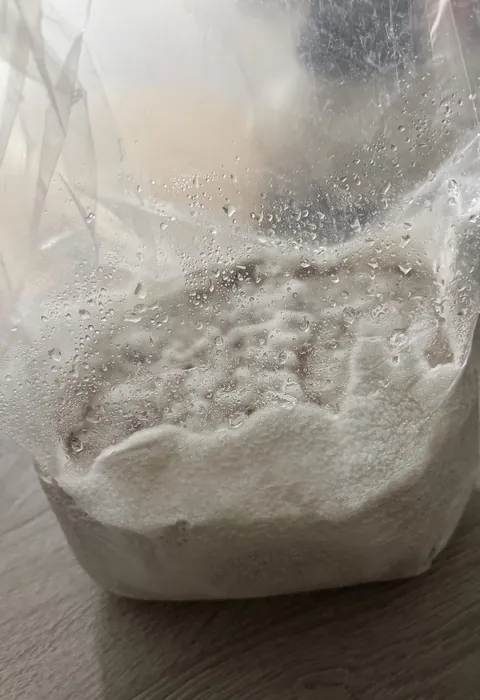
From each point of inoculation the mycelium starts growing through the surrounding sawdust. The separate zones of growth gradually merge into a single mycelial network.
We inspect the bags as they colonize and discard any block that is unsatisfactory or contaminated.
Once the substrate is fully colonized, it is ready for fruiting body development.
Antler morphology
The shape of a Reishi fruiting body is governed above all by air exchange — that is, CO₂ concentration — along with temperature, relative humidity, and light.
With reduced air exchange and a higher CO₂ concentration, cap development is suppressed and the fruiting body continues mainly in elongated growth.
This is how the distinctive antler morphology arises.
Antler Reishi is not a different species of mushroom, but a different form of fruiting body of the same species, arising as a response to growing conditions.
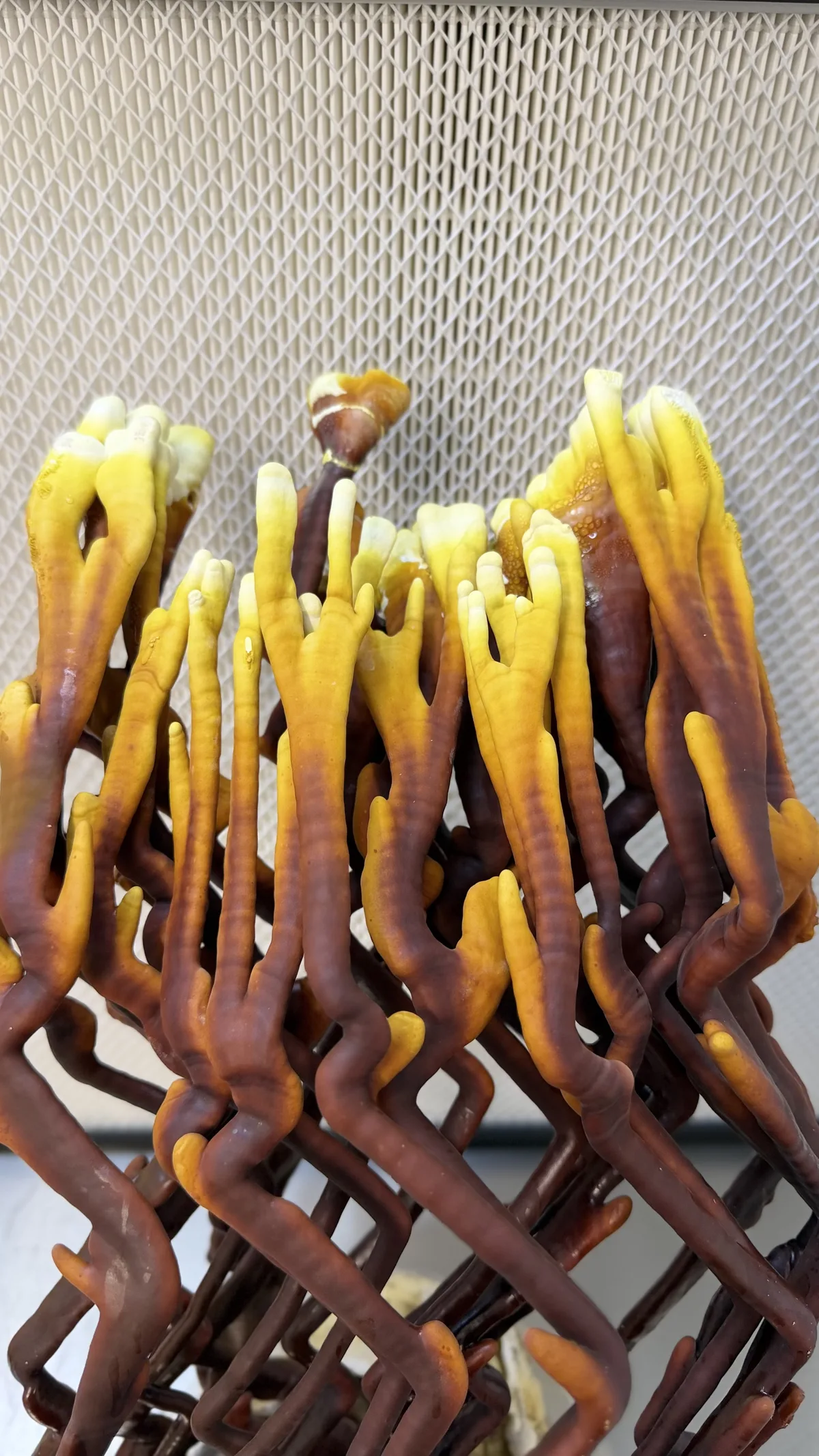
At GoMushroom we often choose this morphology deliberately.
Research indicates that growing conditions and morphology can also affect the chemical profile of the fruiting body.
In controlled trials, antler fruiting bodies showed higher values for some of the analysed components compared with the classic form, among them ganoderic acids and water-soluble polysaccharides.
Numerous triterpenoids have also been isolated from antler Ganoderma fruiting bodies, including some not previously described.
This does not mean that every antler fruiting body automatically contains more of every bioactive compound. Composition is also shaped by the culture, the substrate, the growing conditions, the stage of development, and the time of harvest.
What it does mean is that morphology is not merely a visual property of the mushroom, but a result of growing conditions that can also affect the chemical profile of the raw material.
From cultivation to extraction
For GoMushroom, growing our own is not a separate part of the process.
It is the first step of extraction.
The quality of the finished extract depends not only on how effectively we carry out the extraction, but also on what raw material we put into it.
That is why we join:
culture → cultivation → raw material selection → extraction → formulation
into a single process.
This approach gives us better control over the incoming raw material, traceability, and greater consistency between batches.
GoMushroom is not just a product. It is a process.
References
- Sudheer, S. et al. (2018). Development of antler-type fruiting bodies of Ganoderma lucidum and determination of its biochemical properties. Fungal Biology. DOI: 10.1016/j.funbio.2018.01.007
- Shao, H. et al. (2024). Triterpenes from antler-shaped fruiting body of Ganoderma lucidum. Phytochemistry. DOI: 10.1016/j.phytochem.2024.114148
- Wu, S. et al. (2022). Ganoderma lucidum: A comprehensive review of phytochemistry, efficacy, safety and clinical study. Food Science and Human Wellness. DOI: 10.26599/FSHW.2022.9250051
- Xia, Q. et al. (2014). A Comprehensive Review of the Structure Elucidation and Biological Activity of Triterpenoids from Ganoderma spp. Molecules. DOI: 10.3390/molecules191117478
Interested in collaboration?
GoMushroom brings cultivation, extraction, and formulation together in one process.
If you are interested in Reishi cultivation, in developing a raw material for extraction, or in another production partnership, get in touch.