Plant Extracts • Spruce Buds • Research
What Does Research Say About Spruce Buds?
Spruce buds (Picea abies) are one of the few ingredients that almost everyone recognises from home tradition — yet rarely anyone looks at them as a serious plant material for extraction.
Introduction
Spruce buds are one of the few ingredients that almost everyone recognises from home tradition — yet rarely anyone looks at them as a serious plant material for extraction.
Most people think of syrup first. Sugar, honey, a jar in the sun and a home-made winter preparation.
Researchers, however, look at young spruce shoots differently: as a source of aromatic compounds, phenolics, essential oils, terpenes, piperidine alkaloids and other metabolites that form during intensive spring growth. [1] [2]
This is where an interesting difference begins. Tradition tells us that spruce buds have been important to people for a long time. Research helps us understand which groups of compounds are actually present in these young shoots and why they are so aromatic, resinous and distinctive.
The research base for spruce buds is less extensive than for medicinal mushrooms such as reishi, chaga or lion's mane. Most data comes from laboratory analyses, phytochemical studies and research into individual compounds, not from clinical trials in humans.
For spruce buds, it is therefore most accurate to speak of traditional use, aromatic compounds, phytochemical composition, antioxidant potential and extract research.
What Are Spruce Buds?
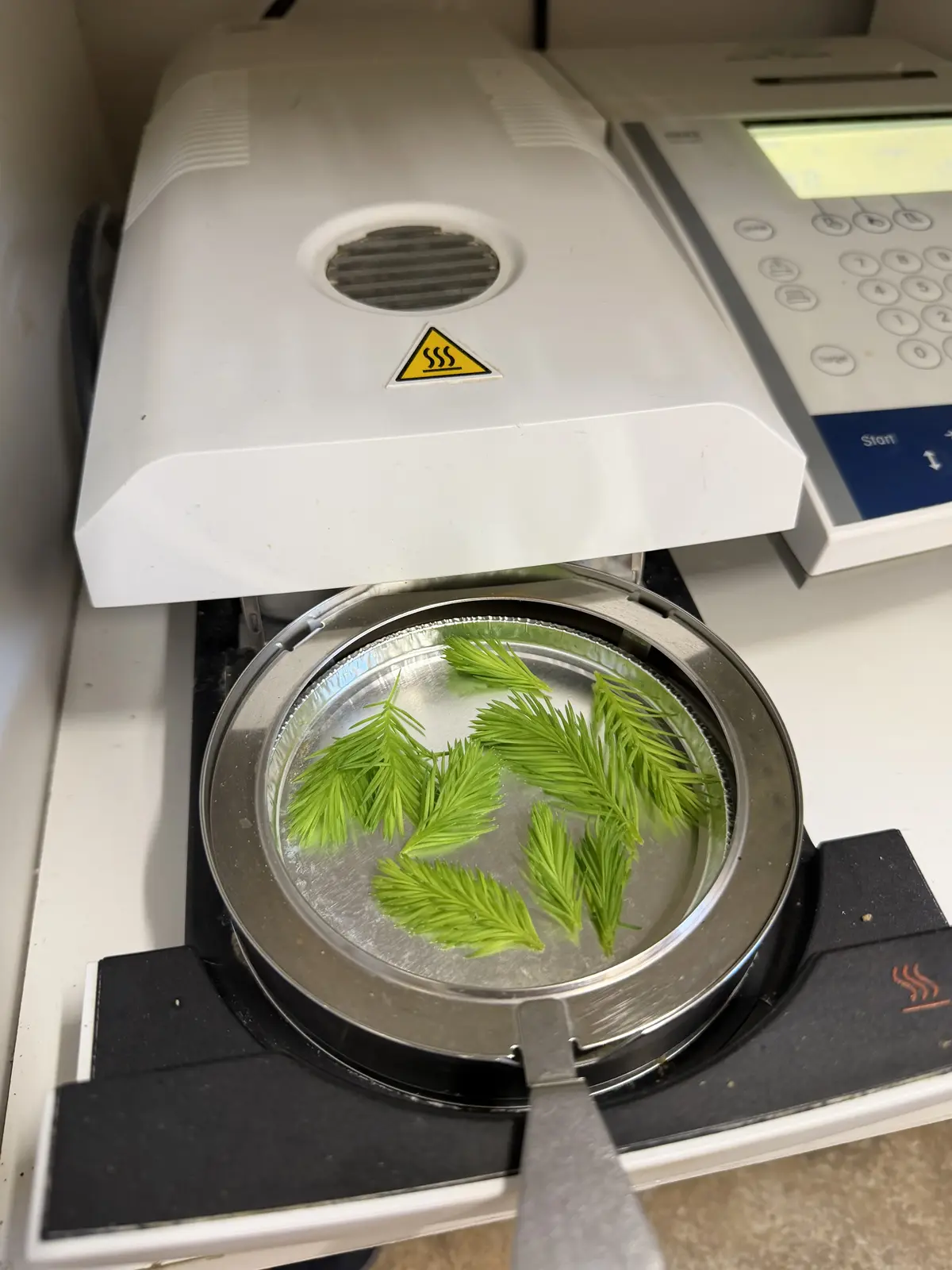
Spruce buds are the young shoots of Norway spruce (Picea abies), which appear in spring at the tips of branches. At this early stage they are soft, bright green, aromatic and rich in plant compounds that give them their characteristic scent and flavour.
This is very young plant material. That matters, because young shoots are not the same as older needles, bark or wood. During the growth phase the plant forms a different profile of compounds associated with growth, protection and environmental response. [1] [2]
Modern research on spruce and its young shoots investigates primarily:
Traditional Use of Spruce Buds
Spruce buds have a long tradition of use in European herbalism. They most frequently appear in connection with syrups, teas, the throat, the respiratory tract and the winter season.
In traditional use they were prepared in various ways:
- as syrup with sugar,
- as a preparation with honey,
- as tea or decoction,
- as an alcohol macerate,
- as an ingredient in lozenges, ointments or baths.
Traditional use is not the same as clinical evidence. It does, however, show how a particular plant material was used throughout history and why it later became interesting to researchers.
For spruce buds, traditional use is not coincidental. Young shoots have a distinctive aroma, a mildly resinous character and a fresh sensation that people quickly associate with the throat, the respiratory season and home preparations.
What Changes When We Stop Seeing Spruce Buds as Just a Syrup?
A classic spruce bud syrup has its value. It is part of home tradition and often the first form through which people encounter this ingredient.
But syrup is not the only way to look at spruce buds.
When we look at them as a plant material for extraction, the question changes. We are no longer just asking how to make a pleasant sweet preparation, but which groups of compounds are present in young shoots and how we can understand them.
Spruce buds are interesting not only because of a sweet syrup. They are interesting because of a combination of:
- the youth of the plant material,
- distinctive aromatics,
- resinous and volatile compounds,
- phenolic compounds,
- terpenes,
- traditional use,
- the possibility of a different extraction approach.
This is an important distinction. Traditional syrup speaks to home use. A research perspective treats spruce buds as a complex plant material.
Quick Overview of Research Areas
Key findings:
- Spruce buds have a long tradition of use in syrups, teas and home preparations.
- Their distinctiveness lies in being a young, aromatic spring shoot with a different profile of compounds than older parts of the plant.
- Researchers studying spruce buds and shoots investigate phenolic compounds, essential oils, terpenes, piperidine alkaloids and antioxidant potential.
- Most current data comes from laboratory analyses, not from clinical trials in humans.
- This article covers primarily the research and compounds. The GoMushroom extraction process is explained in a separate article on spruce bud extract.
Phenolic Compounds and Flavonoids
Phenolic compounds are one of the main groups of bioactive compounds that researchers investigate in spruce and its young shoots.
In a study of vegetative buds of Norway spruce (Picea abies), researchers analysed the phenolic profile of an ethanol extract and investigated its antioxidant and antimicrobial activity. [1]
Phenolic compounds and flavonoids are of interest primarily because they are often associated with the antioxidant potential of plants. It is important to understand, however, that antioxidant activity in a laboratory does not mean the same effect in the human body.
For spruce buds, it is therefore most accurate to speak of research into phytochemical composition and antioxidant potential, not direct clinical effects.
Essential Oils, Terpenes and Aromatic Compounds
The distinctive scent of spruce buds comes from aromatic compounds, among which essential oils and terpenes play an important role.
Studies on vegetative buds of Picea abies have analysed the composition of the essential oil alongside the phenolic profile. [1]
Terpenes and other volatile compounds are an important part of the sensory profile of spruce buds. They contribute to the fresh scent, resinous sensation and aroma that have traditionally linked spruce buds with the throat, airways and the winter season.
This is one of the reasons spruce buds are so recognisable. Their value lies not in any single compound, but in the entire aromatic profile of the young shoot.
Piperidine Alkaloids in Young Spruce Shoots
In addition to phenolic compounds and essential oils, researchers have also investigated piperidine alkaloids in young spruce shoots.
One study showed that 1,6-dehydropinidine is present in higher amounts in young Picea abies shoots than in more mature needles. The fraction containing this compound showed mild antibacterial potential against Streptococcus equi subsp. equi under laboratory conditions. [2]
This does not mean that spruce buds can be treated as an antimicrobial agent in humans. It does mean that young spruce shoots are an interesting material for research into plant compounds that are rarely mentioned in an ordinary conversation about syrup.
Antioxidant Potential
Antioxidant potential is one of the main areas of research for spruce buds and shoots.
In laboratory research, spruce bud extracts have shown antioxidant activity, which researchers link primarily to the presence of phenolic compounds and other plant metabolites. [1]
Research into other parts of spruce — such as bark and cones — also shows the presence of compounds with antioxidant potential. This supports broader interest in spruce as a source of plant bioactive compounds. [3] [4]
These findings help in understanding the composition and potential of the raw material. They do not, however, constitute direct health claims.
Antimicrobial Potential
In addition to antioxidant potential, researchers are also interested in the antimicrobial properties of spruce extracts.
A study of vegetative buds of Picea abies showed antimicrobial activity against some of the microorganisms tested. [1]
Additionally, researchers studying young spruce shoots investigated 1,6-dehydropinidine, which showed mild antibacterial potential under laboratory conditions. [2]
This does not mean that spruce buds can be treated as an antimicrobial treatment in humans. It does mean that aromatic and other compounds from young shoots are of interest in laboratory research.
Spruce Buds, the Throat and the Airways
Spruce buds are most closely associated in traditional use with the throat, cough, airways and the winter season.
This traditional association is likely linked to several factors: aromatic compounds, essential oils, the resinous character of the material and the way it is used — as syrups or teas.
When we take a preparation made from spruce buds, the first thing we notice is precisely the aroma, the mild resinousness and the sensation in the throat. This is part of the sensory experience that has so strongly connected spruce buds with the respiratory season in folk use.
At GoMushroom, we therefore do not present spruce buds as a remedy for coughs or the airways, but as an aromatic, concentrated extract of young plant material with a rich tradition of use.
How This Article Differs from the GoMushroom Extract Article
This article covers primarily what research investigates about spruce buds: phenolic compounds, essential oils, terpenes, piperidine alkaloids, antioxidant and antimicrobial potential and traditional use.
If you are interested in how GoMushroom prepares a concentrated extract from spruce buds and why it is not a classic syrup or tincture, read: Spruce Buds: Why the GoMushroom Approach Is Not a Classic Tincture
There you will find a more detailed explanation of why we measure moisture content in fresh buds, how we approach hydroethanolic extraction, why we use ultrasound and why we understand the final product as a concentrated extract.
What Does Research Currently Show Well?
Research into spruce buds and related parts of spruce clearly shows that this is a phytochemically interesting plant material.
The best-supported areas are:
- the presence of phenolic compounds,
- the presence of essential oils and terpenes,
- laboratory-measured antioxidant potential,
- laboratory-investigated antimicrobial potential,
- the distinctiveness of young shoots compared to older needles.
These are primarily laboratory and phytochemical data. Their value lies in helping us better understand the raw material.
Where Is the Data Still Limited?
The main limitation with spruce buds is the lack of clinical research in humans.
This means that phytochemical and laboratory findings cannot be directly translated into effects in individuals. Equally, traditional use does not mean the same thing as clinical evidence.
The most honest approach with spruce buds is therefore to clearly distinguish between:
- traditional use,
- the composition of the plant material,
- laboratory potential,
- actual clinical evidence.
How We Understand This at GoMushroom
At GoMushroom, we understand spruce buds as a young, aromatic plant material that deserves more than a view through the lens of a classic sugar syrup.
This article is therefore not about health promises, but about compounds, research and traditional context.
Spruce buds are interesting precisely because they stand at the intersection of home tradition and a modern understanding of plant extracts. Tradition shows why people used them. Research shows which groups of compounds are present. And extraction determines which of those compounds actually make it into the final product.
If you are interested in the process side — why our extract is not a classic syrup or ordinary tincture — the natural next step is: Spruce Bud Extract: Why the GoMushroom Approach Is Not a Classic Tincture
Frequently Asked Questions
What do spruce buds contain?
Young shoots of Norway spruce (Picea abies) contain phenolic compounds, flavonoids, essential oils, terpenes, piperidine alkaloids and organic acids. They are young plant material with a different profile of compounds than older needles or woody parts of the spruce tree.
Why are spruce buds more than just an ingredient for syrup?
A classic syrup is just one form of use. When we look at spruce buds as a plant material for extraction, we ask which groups of compounds are present in the young shoots — phenolic compounds, essential oils, terpenes, piperidine alkaloids. Different extraction approaches give access to different compounds that a simple sugar syrup does not fully capture.
Why is the extraction method important for spruce buds?
Different compounds from spruce buds require different extraction conditions. Hydroethanolic extraction allows access to a broader spectrum of compounds than simple water extraction or a classic syrup. Moisture content in fresh buds is a key parameter for adjusting the process.
Where is the data for spruce buds still limited?
The main limitation is the lack of clinical research in humans. Most data comes from laboratory analyses and phytochemical studies. These cannot be directly translated into effects in individuals. Traditional use and laboratory composition are two different things.
Related Articles
References
- Phytochemical Characterization, Antioxidant, and Antimicrobial Activity of the Vegetative Buds from Romanian Spruce, Picea abies (L.) H. Karst. PMC11085860.
- 1,6-Dehydropinidine Is an Abundant Compound in Picea abies Sprouts and Shows Antibacterial Potential. PubMed 33036142.
- Antioxidant and Antibacterial Properties of Norway Spruce (Picea abies) and Eastern Hemlock Cone Extracts. Forests, 12(9), 1189.
- Phytochemical Profile and Biological Effects of Spruce (Picea abies) Bark Extracts. PMC8145950.