Knowledge • Plant Extraction • GoMushroom
Spruce buds: why GoMushroom's process goes beyond a classic tincture
Most spruce bud preparations are based on traditional recipes using sugar, honey or alcohol. These approaches have a long history and their own value. At GoMushroom, we were interested in something different: can a controlled extraction process yield more from spruce buds than just aroma and flavour?
The tradition of spruce syrups — and the question that follows
Young spruce buds have been used for generations — covered in sugar, honey or alcohol and left to macerate for a few weeks. The result is a preparation with a distinctive aroma and flavour, with a long tradition in home herbalism.
These approaches have their value. But a question naturally arises:
Is it possible to obtain more from spruce buds than just flavour and aroma?
At GoMushroom, we took a somewhat different approach. We did not want to produce merely an aromatic preparation. We wanted to develop a concentrated extract of spruce buds, where extraction conditions are not left to chance.
What do spruce buds contain?
Spruce buds do not contain only aromatic substances — they hold a considerably more complex mixture of different plant components. These include:
- volatile aromatic compounds,
- essential oils,
- terpenes,
- resinous components,
- other natural plant substances.
Some of these compounds transfer well into traditional sugar or honey preparations; others require different extraction conditions.
Spruce buds contain various terpenes and other less polar plant components, including compounds such as α-pinene and limonene. These compounds contribute to the characteristic aroma and complexity of spruce buds. Because such compounds are often more soluble in alcohol than in sugar-based preparations, the method of preparation can significantly influence which components actually pass into the final product.
Classic syrups therefore frequently deliver primarily pronounced flavour and aroma. That is not necessarily the same as a concentrated extract with a more diverse profile of extracted plant components.
This article covers the extraction process. If you're interested in what research actually shows about the composition and phytochemistry of spruce buds, read: What Does Research Say About Spruce Buds?
Key differences at GoMushroom
✓ Fresh spruce buds instead of dried material
Fresh buds can retain more volatile aromatic components that may be partially lost during drying.
✓ Moisture content measurement
Before extraction, we determine the water content of the buds using a halogen moisture analyser. Because fresh buds contain a significant amount of naturally present water, this water enters the solvent on contact and affects the actual alcohol concentration in the system.
✓ Adjusted hydroethanolic system
Based on the measured moisture content, we calculate the appropriate starting alcohol strength, so that after mixing with the water from the plant, we create the desired conditions for hydroethanolic extraction of different groups of plant components.
✓ Extraction conditions matched to the material
Different groups of plant compounds do not have the same solubility, so the conditions are not set by a single fixed recipe.
✓ Concentrated extract rather than merely an aromatic preparation
The goal is not simply to capture the flavour of spruce buds, but to obtain a broader and more complex profile of extracted plant components.
Why does moisture content in fresh buds matter?
When fresh plant material is combined with alcohol, water from the plant migrates into the solvent and thereby changes its actual concentration. This is not a negligible effect — spruce buds contain a considerable amount of naturally present water.
At GoMushroom, we therefore do not simply look at how much alcohol is added. Before the process begins, we determine the moisture content of the buds using a halogen moisture analyser. Based on this data, we then select an appropriate alcohol concentration so that, after mixing with the water from the plant, we create a suitable hydroethanolic extraction environment.
Our goal is not simply to add alcohol. The goal is to create a controlled process where the extraction conditions are not left to chance.
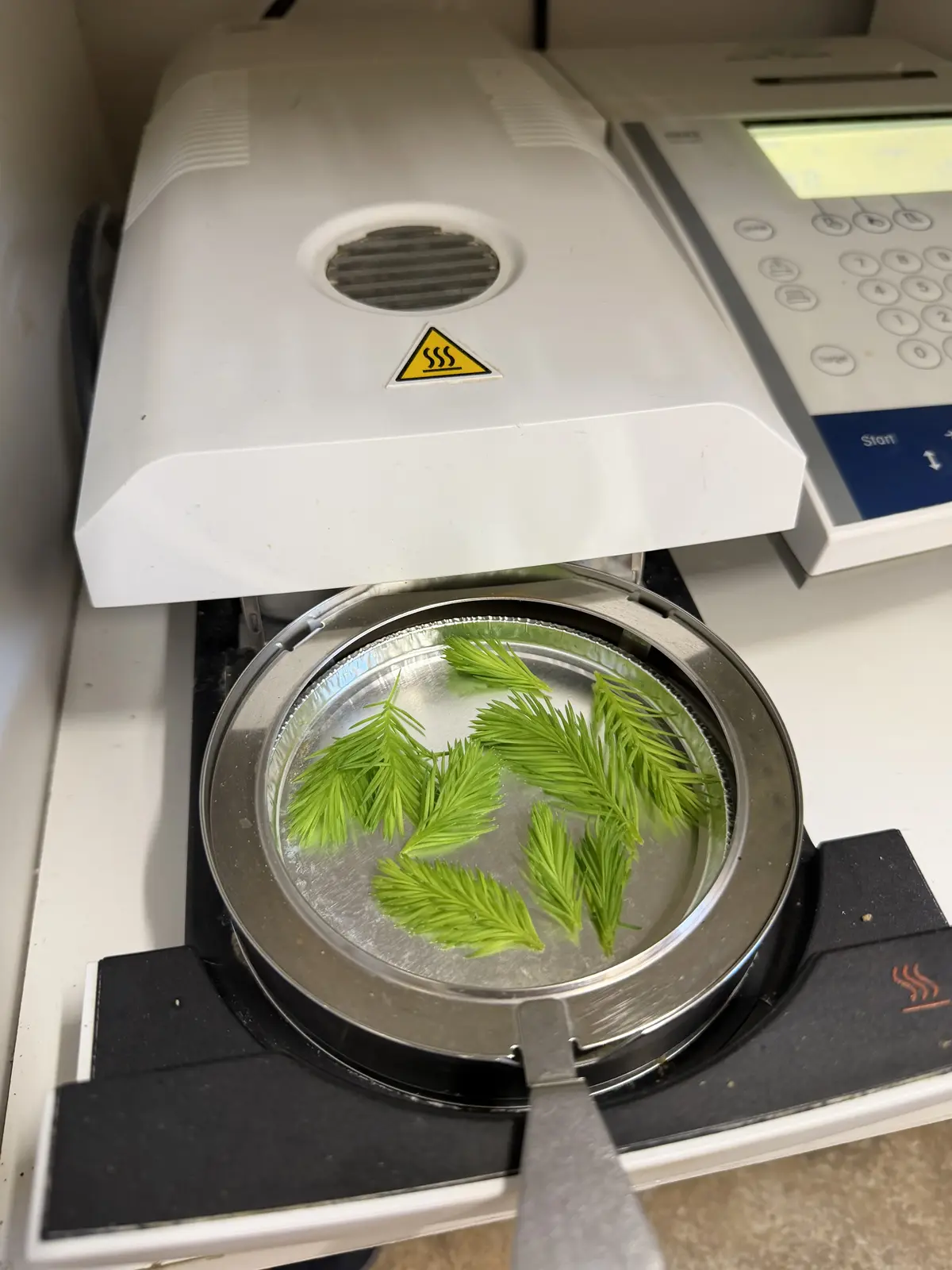
Halogen moisture analyser with a sample of fresh spruce buds. Moisture content is measured before every extraction.
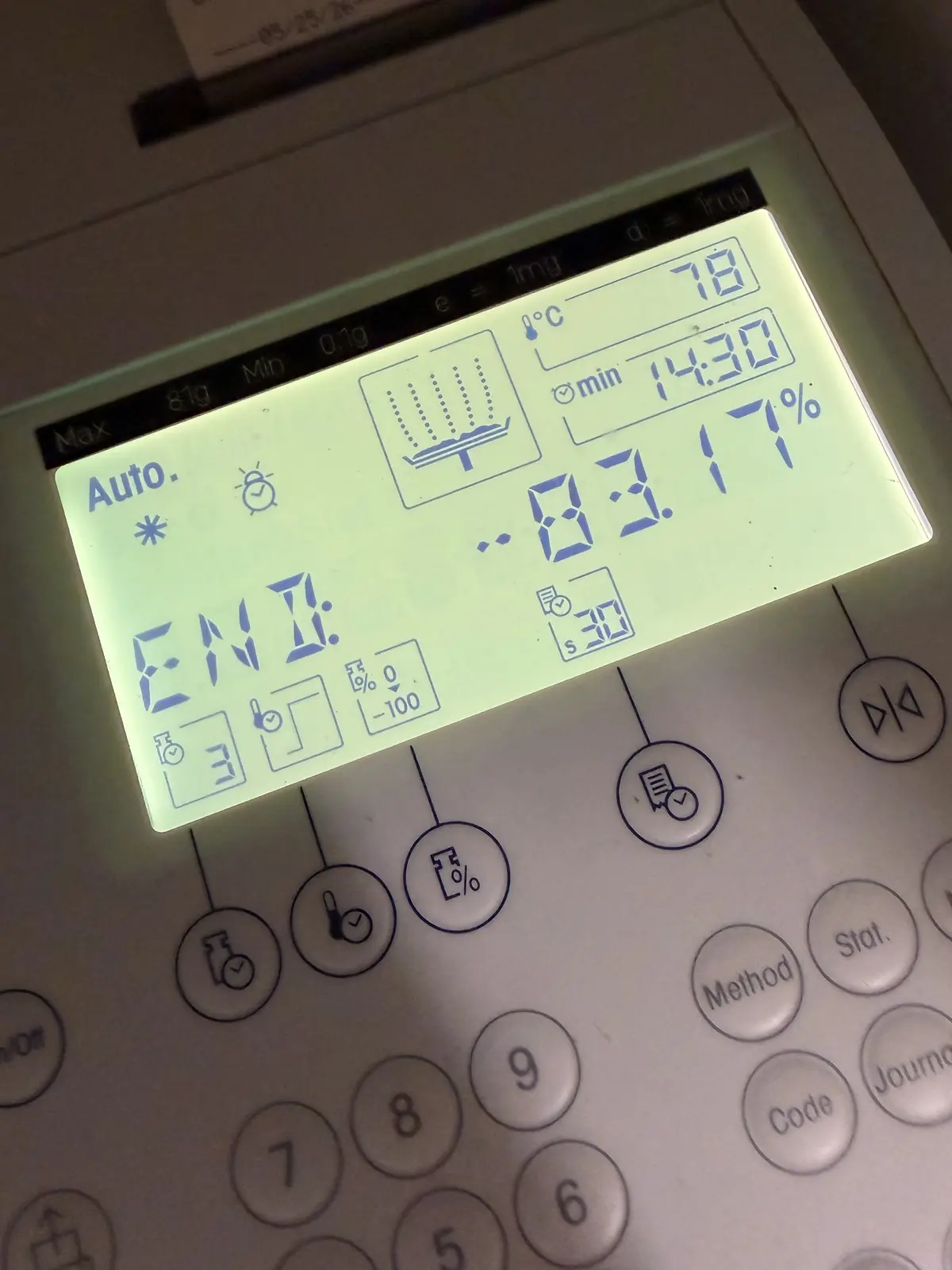
Measurement result: moisture content in fresh spruce buds is 83.17%. Based on this figure, we adjust the alcohol concentration before extraction.
Why is this not a classic tincture?
A traditional tincture is often a fairly simple process: plant material is soaked in alcohol and time does the work. This approach has its merits, particularly for plants that can be effectively extracted through simple maceration.
At GoMushroom, we took a different approach. Our aim was not to produce merely an aromatic preparation, but to create a concentrated extract with the aim of obtaining a broader profile of extracted plant components.
The process includes:
- controlled extraction steps,
- ultrasonic-assisted extraction,
- concentration of the extract,
- monitoring of individual process stages,
- standardisation of the final product.
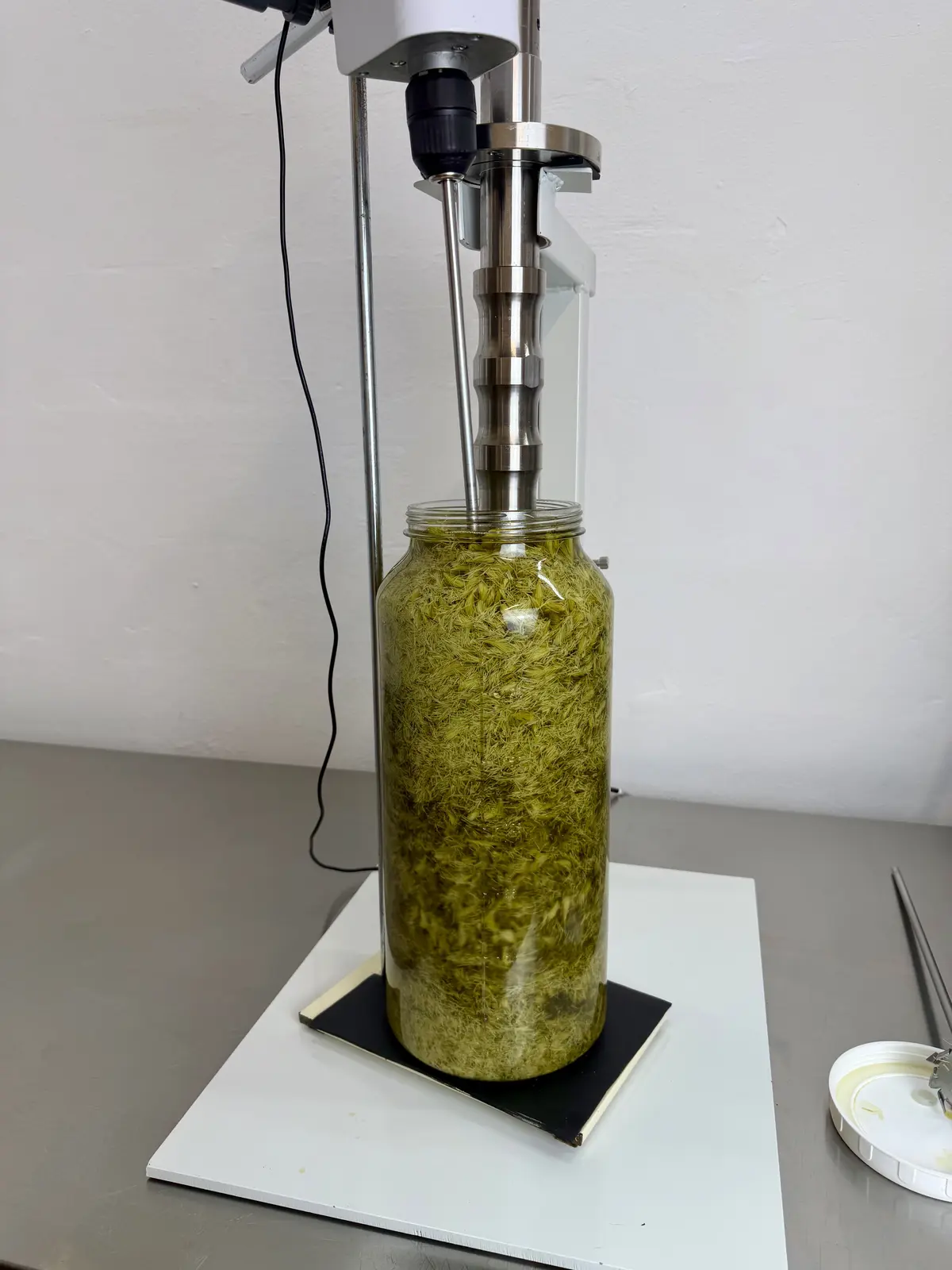
Ultrasonic probe during spruce bud extraction. Ultrasound accelerates the transfer of plant components from the raw material into the solvent.
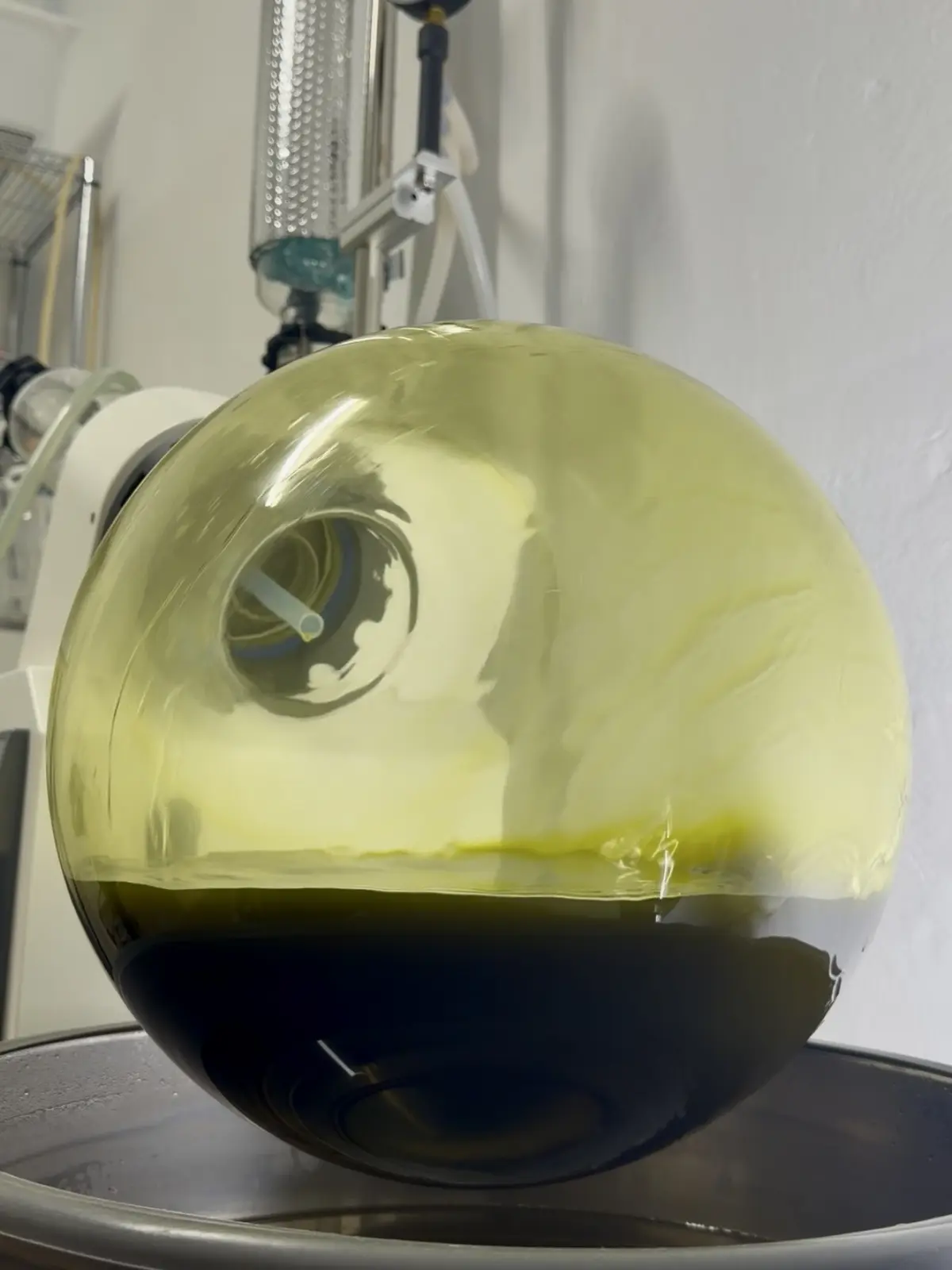
Rotary evaporator concentrating the spruce bud extract. Vacuum evaporation of the solvent increases the concentration of plant components.
The result is neither a classic syrup nor a classic tincture. It is a concentrated extract of spruce buds, where we aim to obtain a more complex profile of plant components from the raw material.
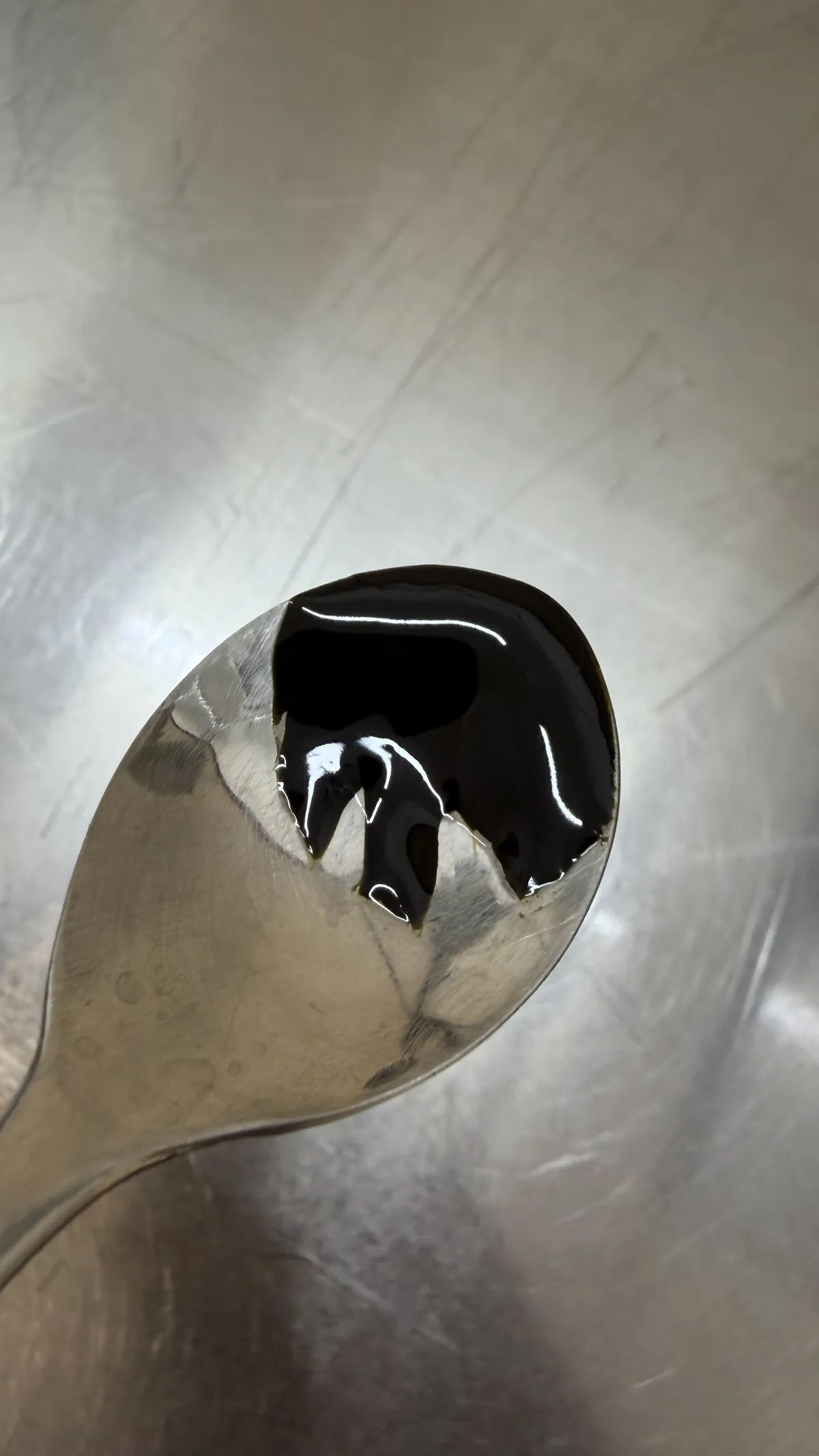
At such a high concentration, the extract is no longer a perfect solution. The resins of spruce buds reach the technological limit of solubility — at high concentration, part of them separates as a dark, viscous paste. After formulation (dilution with the appropriate ratio of water and alcohol), the result is a suspension, which is a normal and expected phenomenon for such a concentrated natural extract.
How to use the spruce bud concentrate
Because this is a concentrated extract, it does not need to be used in the same way as traditional syrups. The options are quite broad.
Direct use
The concentrate can be used on its own in small amounts or as directed on the product.
Preparing spruce syrup
The concentrate can be mixed with honey to produce a thicker preparation with adjustable aroma intensity.
Hot and cold beverages
A small quantity can be added to tea, hot water, mineral water, tonic or lemonade.
Culinary use
Spruce buds are increasingly appearing in modern cuisine — in marinades, dressings, desserts and fermented beverages.
Tradition and a more considered approach
Spruce buds have a long history of use, and that tradition has its own significance. Our aim is not to replace tradition — we wanted to build on it.
We wanted to connect traditional knowledge with a more considered approach to extraction and create a product where the process is as important as the final result.
Most preparations from spruce buds try to capture the taste of the forest. We wanted to capture what remains hidden behind the aroma.
Frequently asked questions
Is this a syrup?
No. This is a concentrated extract of spruce buds, produced through a controlled hydroethanolic process.
Is this a classic tincture?
Not quite. After extraction, part of the solvent is removed, resulting in a more concentrated extract than a classic tincture.
Why do you measure moisture content in the buds?
Because naturally present water affects actual extraction conditions and can alter the hydroethanolic system during extraction. Measuring moisture allows the alcohol concentration to be adjusted before extraction begins.
What does hydroethanolic extraction mean?
It refers to the use of a water–alcohol mixture, which enables the extraction of different groups of plant components.
Does alcohol destroy compounds in spruce buds?
Not necessarily. Alcohol is commonly used as an extraction solvent for compounds that are less soluble in water.
Why use fresh rather than dried buds?
Fresh material can retain more volatile aromatic components that may be partially lost during drying.
Can I make my own syrup with the GoMushroom concentrate?
Yes. You can mix the concentrate with honey or other ingredients to create a syrup with adjustable intensity.
Can the concentrate be used on its own?
Yes, it can be used on its own in small amounts or as directed on the product.
Related articles
References
- Bakkali, F. et al. (2008). Biological effects of essential oils — A review. Food and Chemical Toxicology, 46(2), 446–475.
- Chemat, F. et al. (2012). Green extraction of natural products: Concept and principles. International Journal of Molecular Sciences, 13(7), 8615–8627.
- Azmir, J. et al. (2013). Techniques for extraction of bioactive compounds from plant materials: A review. Journal of Food Engineering, 117(4), 426–436.
- Prado, J.M. et al. (2015). Solubility of plant bioactive compounds in pure solvents and mixtures. Food Research International.
- Tibaldi, G. et al. (2011). Relationships between the chemical characteristics of liqueur preparations with spruce buds. Italian Journal of Food Science.