Education • Extraction Basics • GoMushroom
What Is Extraction? How Compounds Move From Raw Material Into Liquid
Extraction is the process that defines every mushroom tincture and plant extract. It determines which compounds are present, in what concentration, and in what balance.
What Is Extraction
Extraction is the process of transferring compounds from a solid material into a liquid solvent.
It is one of the most widely used processes in food production, plant extract manufacturing, cosmetics, pharmaceuticals and many other fields where specific compounds need to be isolated from a raw material. At first glance it may seem straightforward: place the material in a liquid and the compounds begin to dissolve. In practice, the outcome is influenced by many physical and chemical factors.
The final composition of an extract depends on solvent selection, temperature, extraction time, particle size and the structure of the raw material itself.
How Do We Encounter Extraction in Everyday Life?
Extraction is part of everyday life, even if we rarely think of it in those terms. Brewing tea or coffee is one of the most straightforward examples: when hot water comes into contact with tea leaves or ground coffee, it begins to dissolve and carry various compounds into the liquid.
With tea, water extracts aromatic compounds, polyphenols, pigments and many other water-soluble components. With coffee, extraction significantly affects aroma, bitterness, acidity and the overall character of the drink. In both cases it quickly becomes clear that temperature, time and the ratio of water to material all have a strong influence on the final result — the same principles apply to all extraction processes.
How Does Extraction Work?
Extraction works by allowing a solvent to penetrate the material, dissolve specific compounds and carry them into the liquid phase.
When the solvent comes into contact with the material, it gradually begins to penetrate its structure. During this process, certain compounds start to dissolve and move from the solid material into the surrounding liquid.
This transfer is not instantaneous. It takes place gradually and depends on how quickly the solvent can penetrate the material and how efficiently the compounds dissolve and migrate into the liquid.
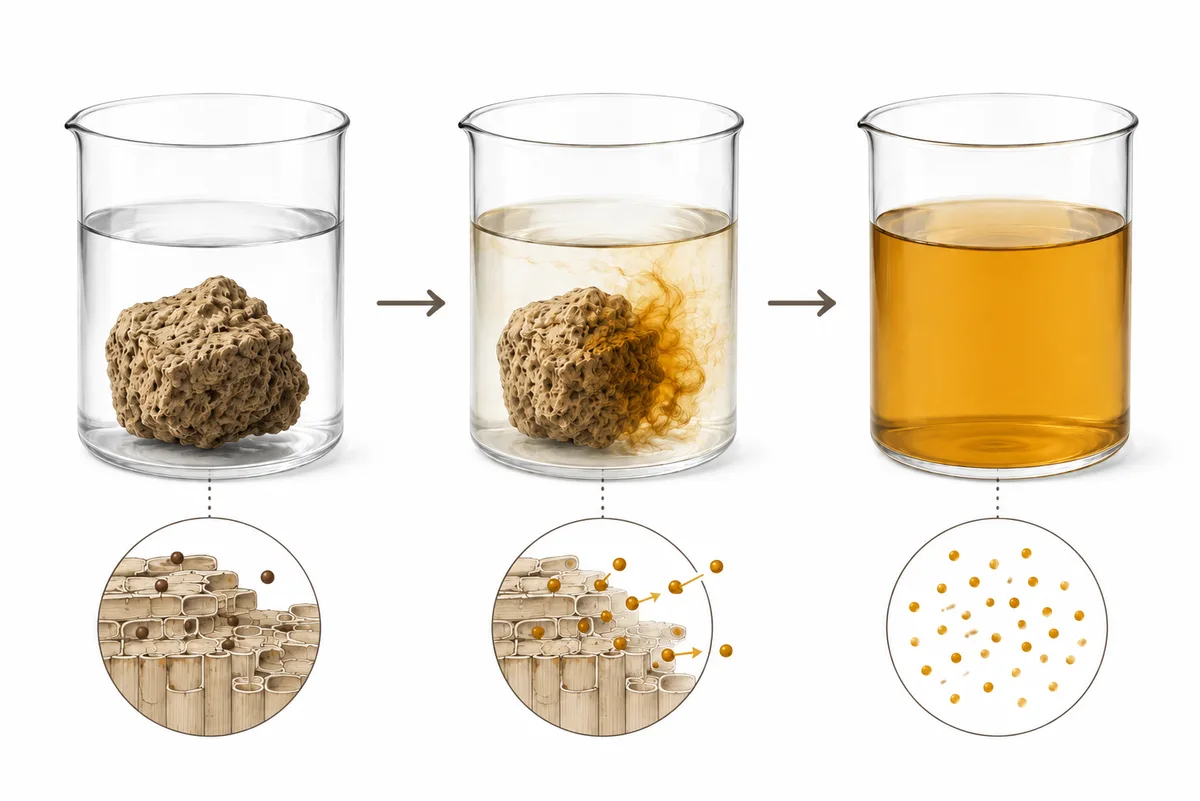
The entire process is driven by diffusion, concentration gradients, temperature and the physical interaction between the solvent and the material.
In practice, this means that extraction does not depend only on the type of solvent, but also on:
- how finely the material is ground,
- how long the extraction takes,
- at what temperature,
- how well the solvent penetrates the material,
- and how much contact the solvent has with the surface of the material.
This is why extraction efficiency can vary considerably between different processes, even when the same raw material is used.
Why Are Different Solvents Used?
Different solvents are used because compounds have different chemical properties and do not dissolve equally in all solvents. Water efficiently extracts primarily more polar and water-soluble compounds, while ethanol is better suited for extracting many less polar or poorly water-soluble compounds, such as certain aromatic molecules, phenols and resins.
As a result, two extracts from the same raw material can have quite different compositions if they were prepared with different solvents. In practice, the choice of solvent is one of the key factors that determines the properties of the final extract.
Why Is Extraction More Than Just Soaking Material?
Extraction is not simply soaking, because the solvent must first penetrate the structure of the material before compounds can move into the liquid. Some materials have a dense, compact or poorly permeable structure, which slows the transfer of compounds — in such cases, simple contact with liquid is often not enough.
The efficiency of the process is therefore significantly influenced by particle size, temperature, agitation, extraction time and the volume of solvent used.
How Does Temperature Affect Extraction?
Temperature affects extraction by changing the solubility of compounds and the rate at which they move into the liquid.
Higher temperatures often improve extraction efficiency, as many compounds dissolve more readily and transfer into the solvent more quickly. On the other hand, excessively high temperatures can increase the degradation of more sensitive compounds. Extraction therefore always involves a balance between efficiency and stability.
Why Is Concentration Often Needed After Extraction?
Concentration is often necessary because extraction typically takes place in larger volumes of solvent. Although larger volumes often improve extraction yield, they also produce a more dilute extract — for this reason, part of the liquid is frequently removed after extraction to obtain a more concentrated final product. This step is usually followed by filtration and removal of solid particles.
Why Does the Extraction Method Matter?
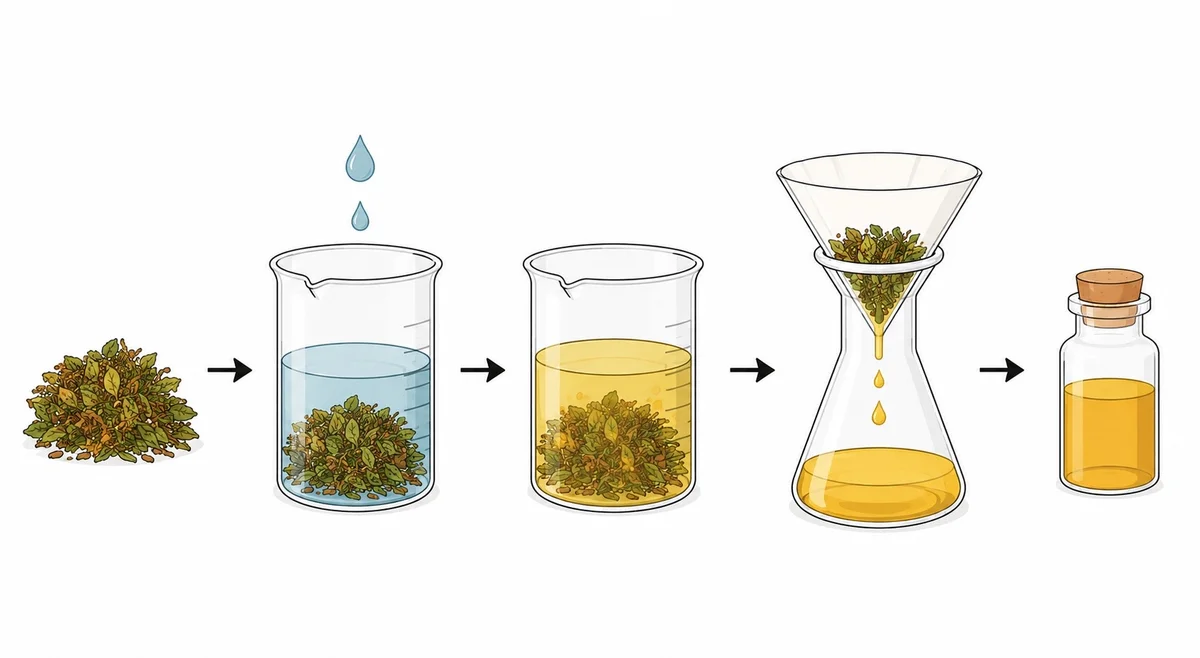
The extraction method matters because it directly determines the composition of the final extract. Two products from the same raw material can differ considerably if they were prepared under different conditions or with different solvents.
Extraction is therefore not just a technical production step, but one of the main factors that defines the properties of the final product. How this plays out in practice with medicinal mushrooms is covered in the article on triple extraction.
Frequently Asked Questions
What is extraction in simple terms?
Extraction is the process of transferring compounds from a solid material into a liquid solvent.
Why are different solvents used in extraction?
Because different compounds dissolve better in different solvents, the choice of solvent has a strong influence on the composition of the final extract.
Is extraction only used for herbs and mushrooms?
No. Extraction is widely used in food production, coffee and tea preparation, cosmetics, pharmaceuticals and many other industries.
Why does temperature matter during extraction?
Temperature influences how quickly and how efficiently compounds dissolve into the solvent.
Related Articles
References
- Azwanida, N. N. (2015). A Review on the Extraction Methods Use in Medicinal Plants, Principle, Strength and Limitation. Medicinal & Aromatic Plants, 4(3).
- Handa, S. S. et al. (2008). Extraction Technologies for Medicinal and Aromatic Plants. UNIDO/WHO.
- European Medicines Agency (EMA). Herbal Product Guidelines.
- United States Pharmacopeia. USP <565> Botanical Extracts.
- Wasser, S. P. (2014). Medicinal mushroom science: Current perspectives, advances, evidences, and challenges. Biomedical Journal, 37(6).
- Zhang, J. et al. Polysaccharide extraction in mushrooms.